13.1 World of Microorganisms
Definition of Microorganisms (No Flashcards)
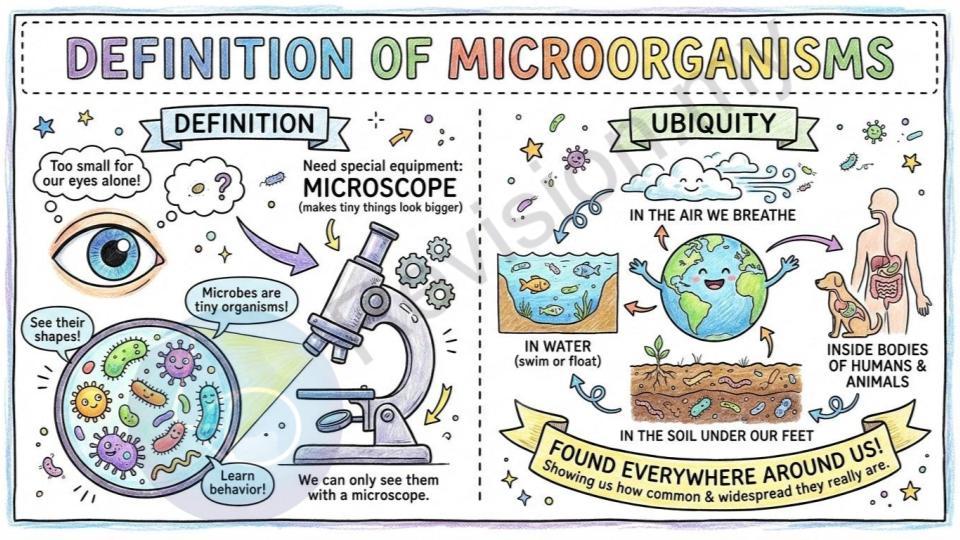
Definition: Microorganisms, or microbes, are tiny organisms that are so small we can only see them if we use a microscope, which is a tool that makes tiny things look bigger. Our eyes alone are not strong enough to see these microbes because they are much smaller than anything we can see. We need special equipment, like microscopes, to see them and learn about their shapes and behavior.
Ubiquity: Microorganisms are found everywhere around us and even inside us. They live in places like water, where they might swim or float around. They also live in the air we breathe, and in the soil under our feet. Some of them even live inside the bodies of humans and animals, showing us how common and widespread they really are.
Classification of Microorganisms (No Flashcards)
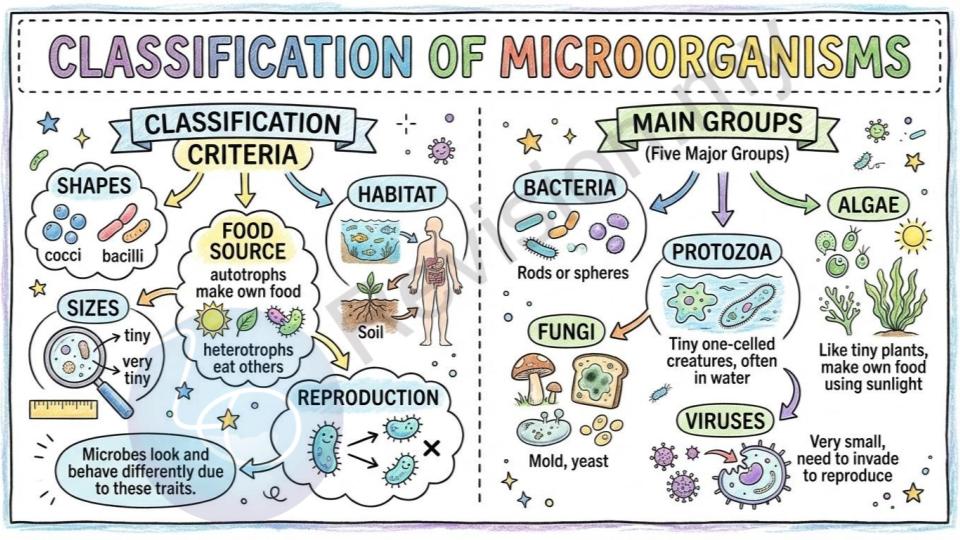
Classification Criteria: Microorganisms are sorted into different groups based on things like their shapes, which can be round or rod-shaped, their sizes, how they get their food (some might make their own food while others eat different things), where they like to live (in water, soil, or inside living things), and how they make more microbes (reproduction). This means that different microbes can look and behave differently because of these traits.
Main Groups: There are five major groups of microorganisms, and each has its own special features that make it different from the others. These groups are bacteria, fungi, protozoa, algae, and viruses. Bacteria can look like rods or spheres, fungi include things like mold and yeast, protozoa are tiny one-celled creatures often found in water, algae are like tiny plants that can make their own food using sunlight, and viruses are so small they need to invade other living things to make more of themselves.
Types of Microorganisms: Detailed Characteristics
Bacteria
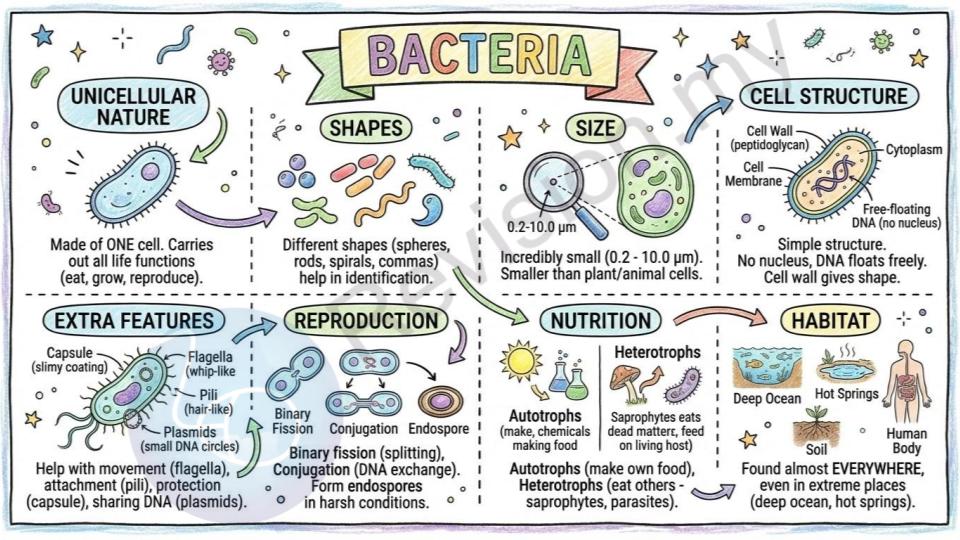
Unicellular Nature: Bacteria are made up of only one cell, which is why we call them unicellular organisms. This single cell carries out all the functions needed for life. Even though they are so tiny and simple compared to bigger living things, they can still do things like eat, grow, and reproduce.
Shapes: Bacteria come in different shapes that scientists have given special names. Some bacteria look like little balls (spheres), others are shaped like rods or straight lines, some look like spirals like curly pasta, and a few look like commas. These different shapes can help scientists identify them.
Size: Bacteria can be incredibly small, with sizes ranging from 0.2 micrometers (which is about as small as a speck of dust) to 10.0 micrometers (which is still too tiny to see with our eyes). This means bacteria are much smaller than the cells that make up plants, animals, and humans.
Cell Structure: Even though bacteria are very small and simple, they have important parts inside them. They have a cell wall made of peptidoglycan that gives them shape and protection. Inside the cell, they have a cell membrane and a jelly-like substance called cytoplasm. Unlike the cells of plants and animals, bacteria don’t have a nucleus. Instead, their DNA floats freely inside the cytoplasm.
Extra Features: Some bacteria have extra parts that help them in different ways. These include capsules, which are like slimy coatings that protect the bacteria, flagella, which are long whip-like tails that help them swim, pili, which are hair-like structures that help them stick to surfaces, and plasmids, which are small circles of DNA that can be shared with other bacteria. These features help them move around, attach to places, or even share genetic information with other bacteria.
Reproduction: Bacteria can reproduce in two ways. Asexually, they reproduce by splitting into two through a process called binary fission, where one cell divides into two identical cells. Sexually, they can exchange pieces of DNA with each other through a process called conjugation, which helps them become stronger or more adaptable. When conditions become really tough, like when it’s too hot or there is no food, they can form endospores, which are protective shells that let them survive until conditions improve. This means bacteria can multiply quickly and survive in harsh conditions.
Nutrition: Bacteria have different ways to get food. Some bacteria are autotrophs, which means they can make their own food from things like sunlight or chemicals. Others are heterotrophs, which means they need to get food from other sources. Some heterotrophs are saprophytes, which eat dead plants and animals, and others are parasites, which feed on living organisms. This means bacteria can survive by eating all sorts of things.
Habitat: Bacteria live almost everywhere you can imagine. They can live in places that seem impossible, like the deep ocean, where there is no light and a lot of pressure, or in hot springs, where the water is boiling. This shows how tough and adaptable bacteria are.
Fungi
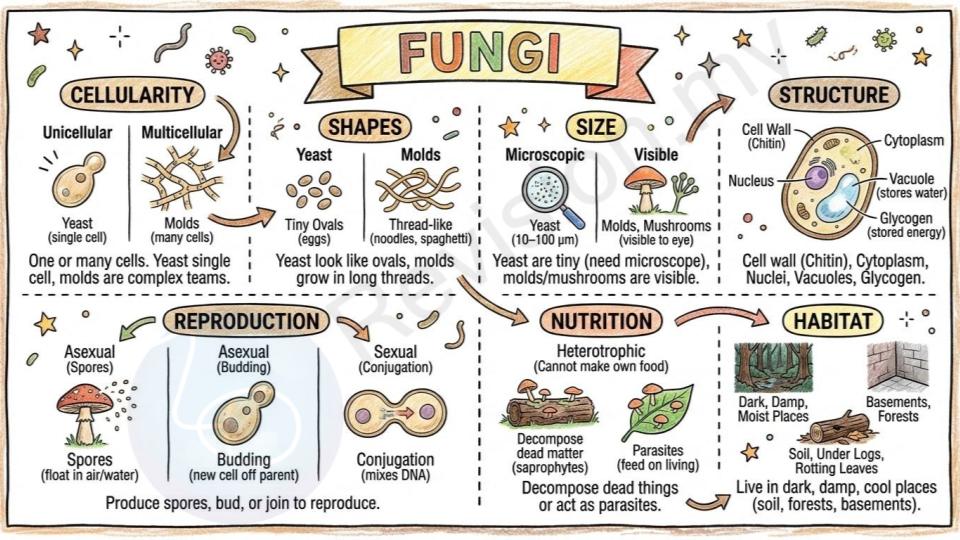
Cellularity: Fungi can be made of only one cell or many cells. When fungi have just one cell, like yeast, they can still do everything they need to live and grow. Moulds are made up of many cells, like a team of cells working together, which makes them more complex and helps them grow larger.
Shapes: Fungi can look different depending on what kind they are. Yeast fungi look like little ovals, kind of like tiny eggs, while moulds grow in long, thread-like shapes that look a bit like noodles or spaghetti. These shapes make it easier for them to spread and cover surfaces.
Size: When fungi have only one cell, like yeast, they are very small, usually between 10–100 micrometers, which is so tiny we need a microscope to see them. However, when fungi are multicellular, like moulds, they can get so big that we can see them with our eyes. Some fungi even grow into large structures, like mushrooms!
Structure: Fungi are made of parts that help them live and grow. They have cell walls made of a substance called chitin, which is strong and keeps their shape. Inside, they have cytoplasm (a jelly-like filling), nuclei (which control the cell’s activities), vacuoles (which store water and nutrients), and glycogen (which is like stored sugar for energy). All these parts work together to help fungi survive and store food so they can grow.
Reproduction: Fungi can make more of themselves in two main ways. Asexually, they can produce tiny cells called spores that float in the air and can land in new places to grow. Some fungi also reproduce by budding, where a small new cell grows off the side of the parent cell. Sexually, they can join two cells together in a process called conjugation, which mixes their DNA. Spores are very useful because they can travel through the air or water and help fungi spread to new places.
Nutrition: Fungi are heterotrophic, which means they cannot make their own food. Instead, they need to get it from outside sources. They can decompose, or break down, dead things like fallen leaves and logs, turning them into nutrients. Some fungi act as parasites, which means they live on or inside other living organisms and take nutrients from them. This shows how fungi can get food in different ways.
Habitat: Fungi like to live in places that are dark, damp, and full of moisture, such as in soil, under logs, or on rotting leaves. They often grow in places where it is cool and shady, because they do not need sunlight like plants do. This means you can find fungi in basements, forests, and other wet, shady areas.
Protozoa
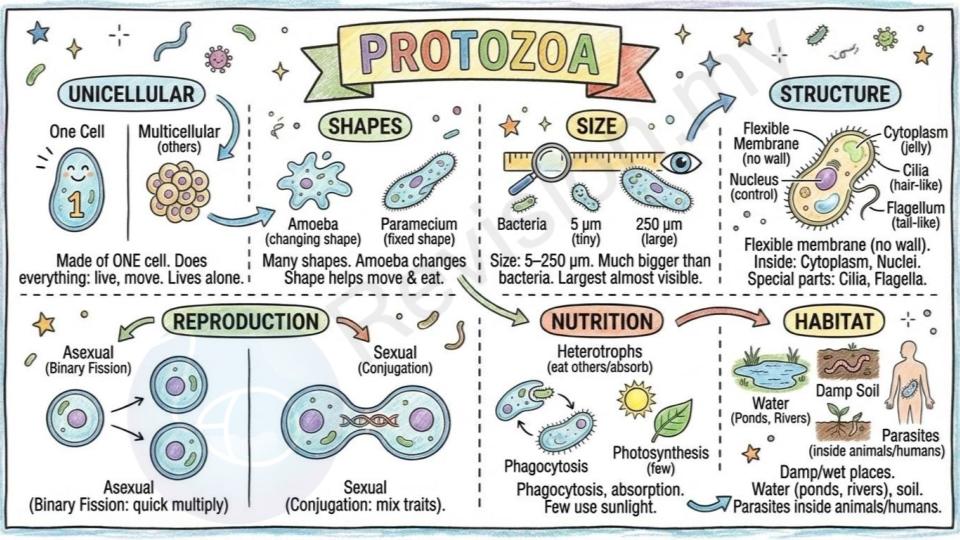
Unicellular: Protozoa are made up of just one cell, which means they are single-celled organisms. Even though they are simple and small, this one cell can do everything needed for them to live and move around. They live on their own, without joining other cells, unlike some other organisms that are multicellular.
Shapes: Protozoa come in many different shapes. Some of them, like the Amoeba, can change their shape all the time by extending parts of their cell, kind of like stretching out. Others keep a regular shape that stays the same. This ability to change shape helps some protozoa move and eat.
Size: Protozoa are usually between 5 and 250 micrometers, which means they can be very small or quite large when compared to bacteria. Even the smallest protozoa are much bigger than most bacteria, and the largest ones can almost be seen with our eyes.
Structure: Protozoa do not have cell walls like bacteria or fungi. Instead, they have a flexible membrane that holds everything inside. Inside this membrane, they have cytoplasm, which is like a jelly filling, and nuclei, which control the cell’s activities. Some protozoa also have tiny hair-like parts called cilia or long tail-like parts called flagella, which help them swim through water or move to find food. These special parts help them survive and get food more easily.
Reproduction: Protozoa can make more of themselves in two ways: asexual reproduction and sexual reproduction. Asexual reproduction happens through a process called binary fission, where one protozoan splits into two identical ones. This lets them multiply really quickly and increase their numbers. Sexual reproduction happens through a process called conjugation, where two protozoa share their genetic material. This helps them create new generations with mixed traits, which helps them survive better in their environments.
Nutrition: Protozoa are heterotrophs, which means they cannot make their own food like plants do. Instead, they eat other organisms or absorb nutrients from their surroundings. Some protozoa feed by phagocytosis, where they wrap their cell around food particles and swallow them. Others absorb nutrients through their cell membrane. A few protozoa can also make their own food using sunlight, through photosynthesis, but most prefer to eat tiny organisms like bacteria.
Habitat: Protozoa can live in many different places, especially places that are damp or wet. They are often found in water, like ponds, lakes, and rivers, or in moist soils. Some protozoa live inside the bodies of animals and humans as parasites, where they feed and grow. This means protozoa can be found in both natural and living environments where there is moisture and food.
Algae
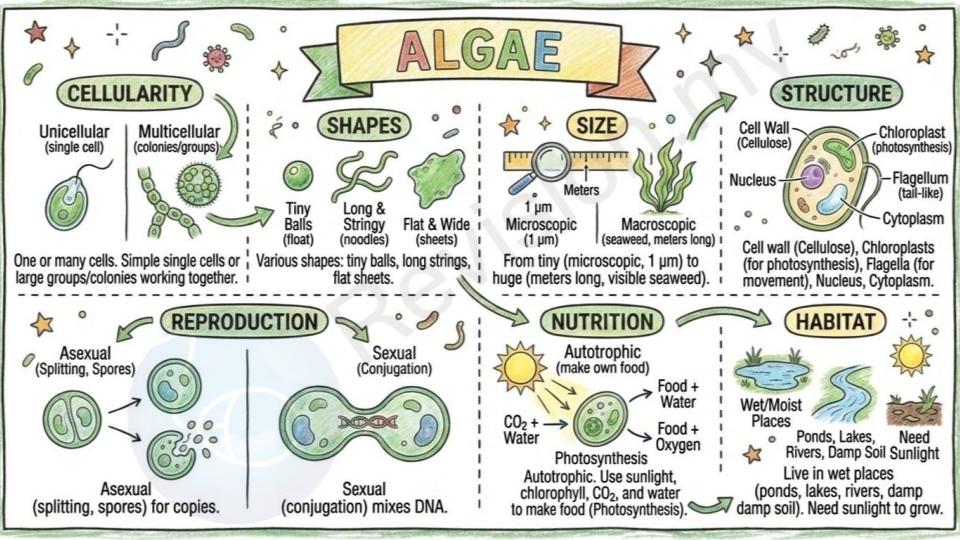
Cellularity: Algae can be made of just one cell or many cells. Some algae are simple, single-celled organisms that live alone, while others form big groups or colonies that work together. These groups can grow large and are made of many tiny cells connected to each other, which helps them survive and thrive.
Shapes: Algae can come in different shapes. Some look like tiny balls that float around in the water, others are long and stringy like thin noodles, and some are flat and wide like little sheets. These shapes help them move, float, or catch sunlight more easily.
Size: Algae can be very small or very big. Some are only 1 micrometer long, so tiny that we need a microscope to see them, while others, like seaweed, can grow several meters long and are easy to see with our eyes. This means algae can be as small as a speck of dust or as big as a tree branch.
Structure: Algae have important parts that help them live and grow. Their cell walls are made of cellulose, which is a tough material that gives them shape and strength. Inside their cells, they have chloroplasts, which contain green pigment to help them make food from sunlight through photosynthesis. Some algae also have flagella, which are like little tails that help them swim and move through water. These parts work together to help algae survive and produce their own food.
Reproduction: Algae can reproduce in two ways. They reproduce asexually by making exact copies of themselves, such as by splitting into new cells or releasing spores that float through water or air and settle in new places to grow. They can also reproduce sexually through a process called conjugation, where two algae cells come together and exchange genetic material to make new algae cells. This helps them spread and adapt to their environment.
Nutrition: Algae are autotrophic, which means they make their own food. They do this by using a green substance called chlorophyll, which captures energy from sunlight and uses it to change carbon dioxide and water into food. This process is called photosynthesis, and it helps them grow and produce energy.
Habitat: Algae live in places that are wet or have a lot of moisture, such as ponds, lakes, rivers, and even damp soils. They need sunlight to make their food, so they are often found near the surface of water or on damp ground where there is plenty of light. Without water and light, they cannot grow properly.
Viruses
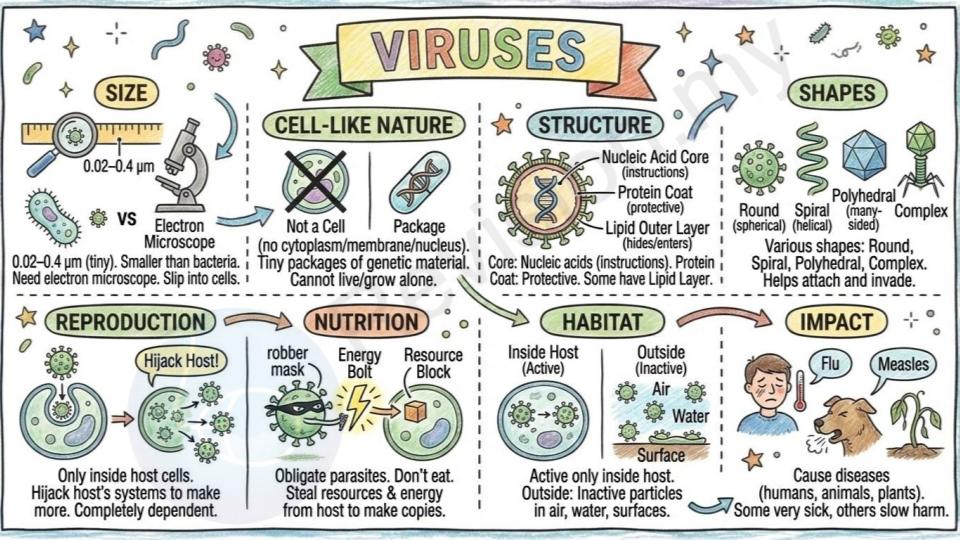
Size: Viruses are incredibly tiny, measuring between 0.02 to 0.4 micrometers. This means they are much, much smaller than bacteria, and we can only see them using powerful electron microscopes. Their tiny size allows them to slip through tiny spaces and even into cells.
Cell-Like Nature: Unlike other microorganisms, viruses are not made up of cells. They do not have cytoplasm, membranes, or nuclei like normal living cells do. Instead, they are like tiny packages that carry genetic material. This means they cannot live or grow on their own; they need to infect a living cell to reproduce.
Structure: A virus is made up of a core of nucleic acids, which are like the instructions for making new viruses, surrounded by a protective coat made of proteins. Some viruses also have an extra outer layer made of fat-like molecules called lipids. This outer layer helps them hide from the body’s defenses and get into cells more easily.
Shapes: Viruses come in many different shapes, including round (spherical), spiral (helical), many-sided (polyhedral), and complicated shapes with both straight and curved parts (complex). These shapes help viruses attach to their host cells and invade them.
Reproduction: Viruses can only reproduce inside the living cells of their hosts because they do not have the machinery to do it by themselves. They hijack the host cell’s systems and force it to make more viruses. This means they are completely dependent on living things to multiply.
Nutrition: Viruses are called obligate parasites because they do not need to eat food or use nutrients like living cells do. Instead, they steal the resources and energy of the host cells to make copies of themselves. They use the host’s machinery to build more virus parts.
Habitat: Viruses can only exist inside living cells where they are active and multiplying. When they are outside a living cell, they do not do anything and just float around as inactive particles. They can stay in the air, water, or on surfaces waiting to find a new host cell.
Impact: Many viruses cause diseases in humans, animals, and even plants. Some viruses make people or animals very sick, like the flu or measles. Other viruses might not make people sick right away, but they can still spread to others or harm the body slowly.
Normal Flora
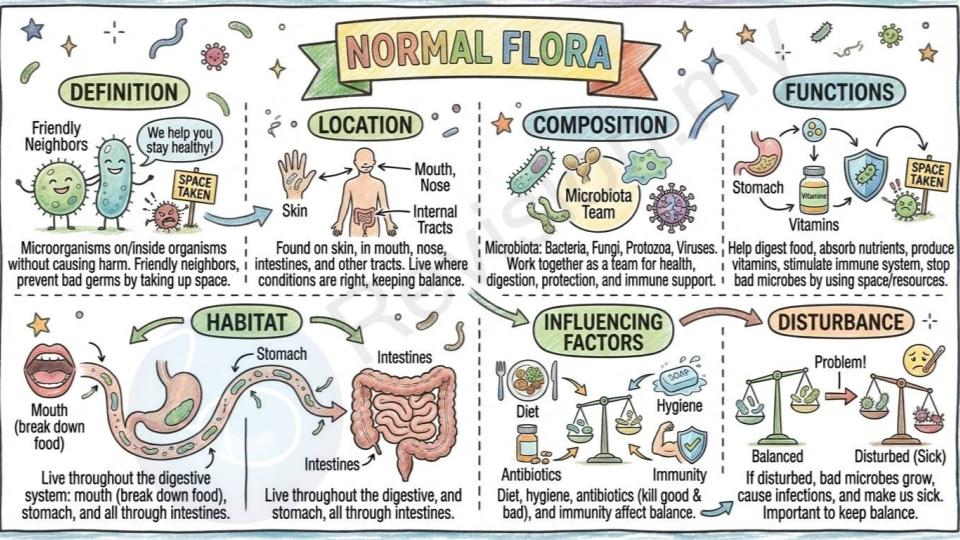
Definition: Normal flora are microorganisms that live on or inside organisms, including humans, without causing harm. They are like friendly neighbors in our body. Instead of making us sick, they often help us stay healthy by taking up space that bad germs might otherwise use.
Location: Normal flora are found in many places in our body, such as on our skin, inside our mouth, in our nose, and lining our intestines and other internal tracts. They live wherever conditions are just right for them, helping to keep these places balanced.
Composition: The microbiota, which is another word for the normal flora, is made up of many different types of microorganisms. These include bacteria, fungi, protozoa, and even viruses. They work together as a team to keep our bodies healthy by helping with digestion, protecting us from harmful microbes, and supporting our immune system.
Functions: The normal flora in our bodies do many important jobs. They help us digest our food so our bodies can absorb the nutrients we need to grow and be healthy. They also produce vitamins, which are nutrients that our bodies need to work properly. These microorganisms can stimulate our immune system, making us stronger and more able to fight off harmful germs. They also stop bad microorganisms from taking over by taking up space and using resources. All these things help us stay strong and healthy.
Habitat: The normal flora live in many places inside our digestive system. They can be found in our mouths, where they help break down food, in our stomachs, and all through our intestines. They are found along the entire length of the digestive tract and work in different ways in different parts.
Influencing Factors: Many things can change the balance of our normal flora. For example, what we eat affects which microorganisms are in our body because different foods help different types of microbes grow. Our hygiene, or how we keep ourselves clean, can also change the kinds of microbes living on us. Taking antibiotics can kill some of the good microbes along with the bad ones, and our immunity, or how strong our body’s defenses are, can also affect the balance. This means that a lot of things we do can change our normal flora.
Disturbance: If the normal balance of microbes in our body is disturbed, it can cause problems. For example, if the good microbes are killed or removed, bad microbes might have a chance to grow and cause infections. When the balance is upset, we might get sick more easily. This shows how important it is to keep our normal flora healthy and balanced.
Factors Influencing Microbial Growth
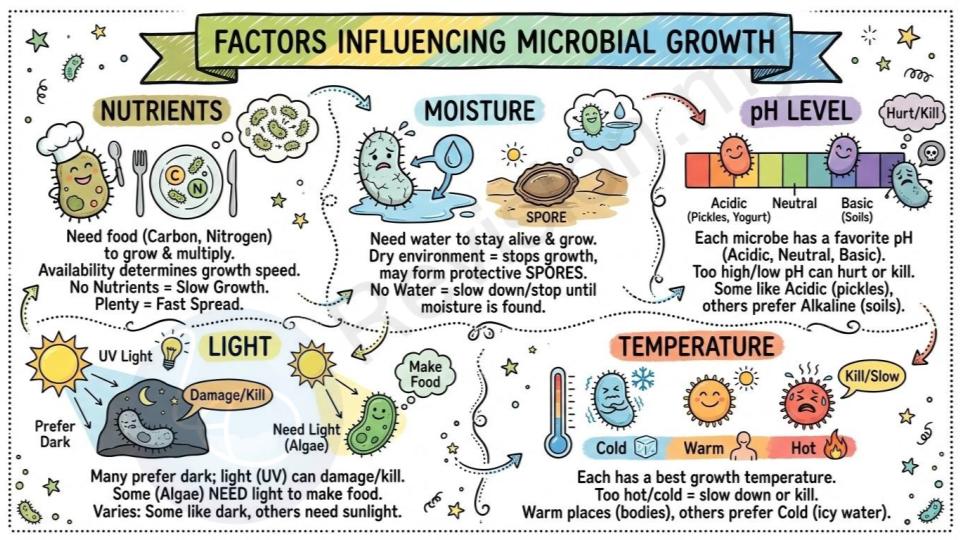
Nutrients: Microorganisms need food, like carbon and nitrogen, to grow and multiply. The availability of these nutrients determines how fast they can grow. Without enough nutrients, they can’t grow well, but with plenty of nutrients, they can grow and spread quickly.
Moisture: Microorganisms need water to stay alive and grow. If the environment is too dry, it can stop them from growing, and some microbes might create spores, which are like protective shells that help them survive tough conditions. Without water, they slow down or stop growing until they find moisture again.
pH Level: Each type of microorganism has its favorite level of pH, which tells us if something is acidic, neutral, or basic. If the pH is too high or too low for them, it can hurt or kill them. Some microorganisms like acidic environments, like in pickles or yogurt, while others prefer alkaline places, like certain soils.
Light: Many microorganisms prefer to grow in the dark because light, especially UV light, can damage or kill them. However, some microorganisms, like algae, need light to make their own food. This shows that while some microbes like the dark, others need sunlight to live.
Temperature: Every microorganism has a temperature it grows best in. If it gets too hot or too cold, it can slow them down or even kill them. Some microorganisms like warm places, like in our bodies, while others prefer cold environments, like icy water.