1.1 Personal Protective Equipment
Definition (No Flashcards)
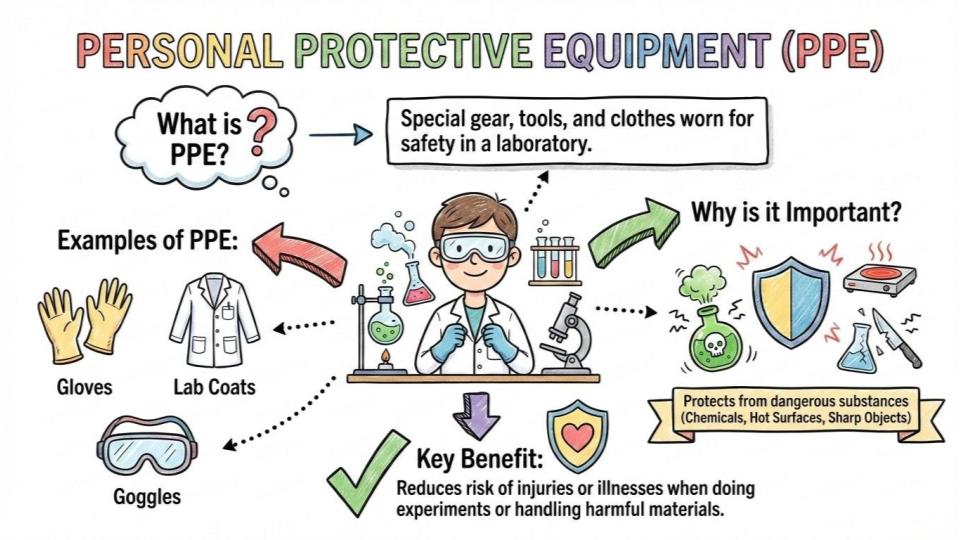
What is PPE?:
- Personal Protective Equipment (PPE) means the special gear, tools, and clothes that people wear to stay safe while working in a laboratory.
- These items include things like
- gloves,
- lab coats
- goggles.
- PPE is important because it helps protect people from coming into contact with dangerous substances like chemicals, hot surfaces, or sharp objects.
- These substances can hurt you or make you sick, so wearing PPE reduces the risk of injuries or illnesses when doing experiments or handling harmful materials.
Types of PPE and Their Functions
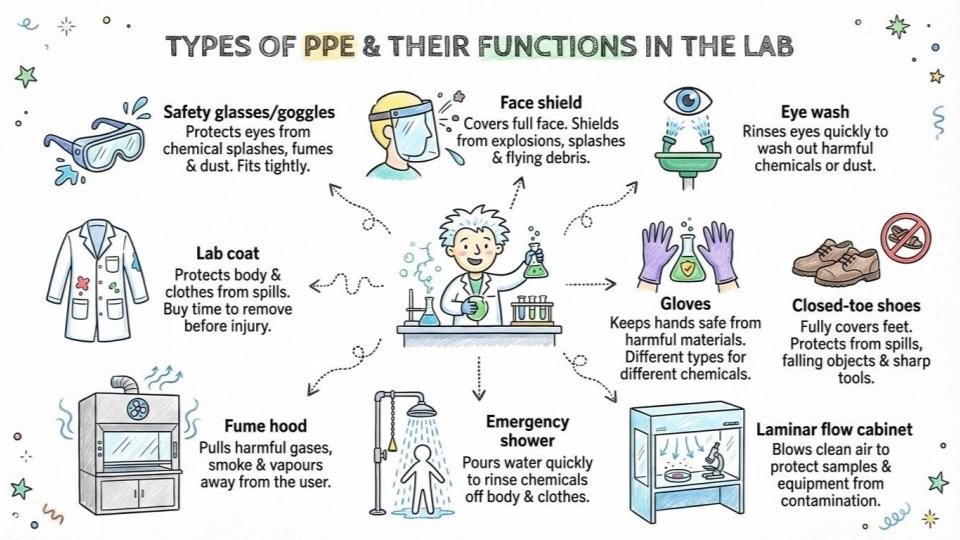
Lab coats: A lab coat is a long, protective coat that you wear over your clothes. It helps protect your body and your clothing from spills, splashes, and contamination. If a chemical splashes on your coat, it won’t touch your skin right away. This gives you time to take the coat off before getting hurt. Lab coats are usually made from materials that are hard to burn or easy to clean, making them very useful in the lab.
Safety glasses/goggles: These are special types of glasses that cover and protect your eyes. In the lab, chemicals can sometimes splash or create fumes that can hurt your eyes badly. Safety glasses or goggles are made from strong, clear materials and fit tightly on your face to block splashes, dust, and fumes. This way, your eyes stay protected while you’re doing experiments.
Gloves: Gloves are worn on your hands to keep your skin safe from harmful materials. For example, if you’re working with acids or cleaning agents, wearing gloves helps prevent those chemicals from burning or irritating your hands. There are different types of gloves made from different materials. Neoprene gloves are good for working with strong chemicals, while vinyl gloves are useful for lighter tasks. Wearing the right gloves helps you work safely and comfortably.
Face shield: A face shield is a large, clear screen that covers your whole face, not just your eyes. It’s especially important when you’re working with things that could explode, splash, or send tiny pieces flying. The shield keeps your face safe from getting cut, burned, or hurt by flying bits or hot liquids. You usually wear it along with goggles or safety glasses for extra protection.
Closed-toe shoes: These are shoes that fully cover and protect your feet, especially your toes. In the lab, open-toe shoes like sandals are not safe because chemicals might spill or things might fall on your feet. Closed-toe shoes are made from sturdy materials, and they stop chemicals or sharp tools from hurting your feet. Always wear them when working in a lab.
Fume hood: A fume hood is like a big box with a fan inside. When you’re working with chemicals that create strong smells, smoke, or toxic vapours, the fume hood pulls all those harmful gases away from your face and body. It sends the bad air outside or filters it so that you don’t breathe it in. This helps keep the air around you clean and safe to breathe while you work.
Laminar flow cabinet: This cabinet is used not to protect people, but to protect the materials you’re working with. It blows clean, filtered air across your work area to stop germs, dust, and other particles from getting into your samples or equipment. This is especially important in experiments where cleanliness is very important, like growing bacteria or handling medicine. It helps your experiment stay safe and not get ruined by outside germs or dirt.
Emergency shower: This is a special shower found in laboratories that is used only when there’s an emergency. If a dangerous chemical spills on your skin or clothes, you need to rinse it off right away. The emergency shower pours lots of water quickly to help wash away the chemical before it can cause burns or other injuries. It’s usually placed in easy-to-reach areas in case something bad happens fast.
Eye wash: An eye wash station is used if something dangerous, like a chemical or dust, gets into your eyes. It sprays water gently into your eyes to wash out anything harmful. You have to use it quickly after your eyes are exposed so the water can help stop the chemical from causing damage. It’s one of the most important safety tools in the lab for protecting your eyesight.
Welcome to the Explainer
Today, we’re stepping into the laboratory—this incredible place of discovery. But here’s the thing: it’s also an environment that demands your respect. To unlock its secrets, you first have to master the knowledge to navigate it safely.
Think about it for a second. You’re in a room full of powerful chemicals and advanced equipment. What’s the most powerful tool you have? It’s the knowledge to stay safe. Yes, it’s that simple. Understanding how to protect yourself isn’t just a boring list of rules—it’s the foundation of all good science. Today, we’re going to build that foundation piece by piece.
Putting Knowledge into Practice
So, how do we apply this knowledge? We start by building what I like to call your personal safety shield. This isn’t just about following rules—think of it as professional armor that every scientist gears up with before beginning their work. It’s a ritual, a sequence that prepares you for discovery. Each piece builds on the last to ensure you’re fully protected.
- The Lab Coat – More than just a uniform, its real job is to buy you precious seconds. If a chemical splashes, it hits the coat first, giving you time to react before it reaches your skin.
- Closed-Toe Shoes – Non-negotiable. They protect you from spills on the floor or dropped equipment.
- Safety Goggles – Essential. They create a complete seal, shielding your eyes from splashes and fumes.
- Face Shield – For higher-risk tasks, this adds another layer. Wear it with goggles, not instead of them, for maximum protection.
- Gloves – A critical barrier for handling materials safely.
- Neoprene – Resists tough chemicals.
- Vinyl – For lighter tasks.
- Note – Using the wrong gloves can be as dangerous as wearing none at all.
Beyond Personal Gear: Lab Safety Systems
Now, let’s zoom out. Beyond your personal shield, labs rely on engineered safety systems.
- Fume Hood – Protects you by pulling harmful vapors away from your face.
- Laminar Flow Cabinet – Protects your sample by bathing it in sterile air to prevent contamination.
Emergency Lifelines
Even with the best preparation, accidents happen. That’s why labs have emergency lifelines:
- Emergency Shower – For major chemical spills on skin or clothing, it drenches you instantly to prevent serious burns.
- Eyewash Station – If anything gets past your goggles, flush your eyes immediately with a steady stream of water.
Time is critical: You must reach these within 10 seconds. Hesitation can be dangerous.
The Bigger Picture: Safety and Discovery
All these rules and gears might seem like obstacles, but they’re not. They’re the foundation that enables scientific progress. They create a space where scientists can focus, push boundaries, and make breakthroughs.
The takeaway? Safety isn’t the opposite of progress—it’s its partner. Mastering safety tools empowers you to do bold, world-changing science. It’s not about fear; it’s about respect and confidence to do the work the right way.