1.3 Fire Extinguishers
Definition (No Flashcards)
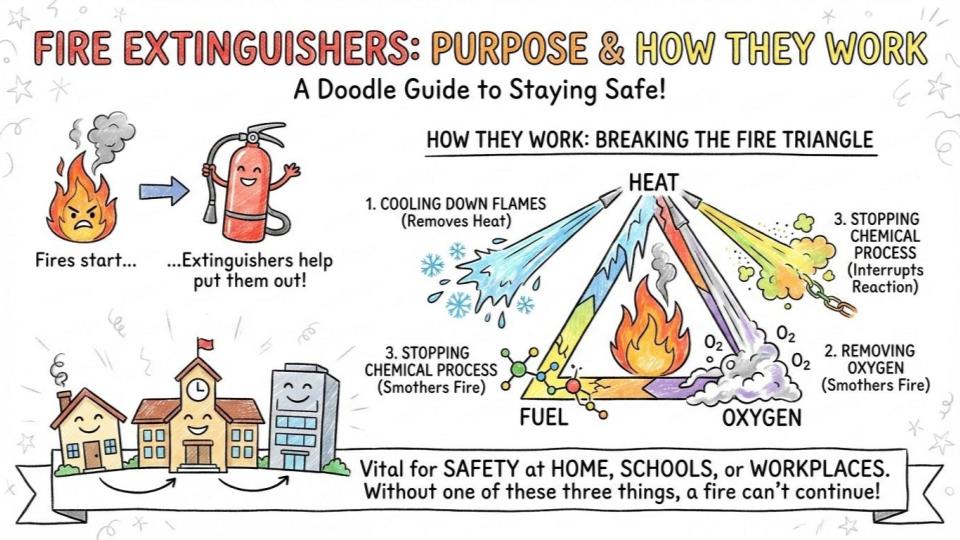
Purpose of fire extinguishers: Fire extinguishers are tools that help us put out fires when they start. They work by using different methods such as cooling down the flames, removing the oxygen that keeps the fire burning, or stopping the chemical process that causes the fire to keep going. Without one of these three things, a fire can’t continue, so fire extinguishers are very important for safety at home, in schools, or in workplaces.
Types of Fire Extinguishers
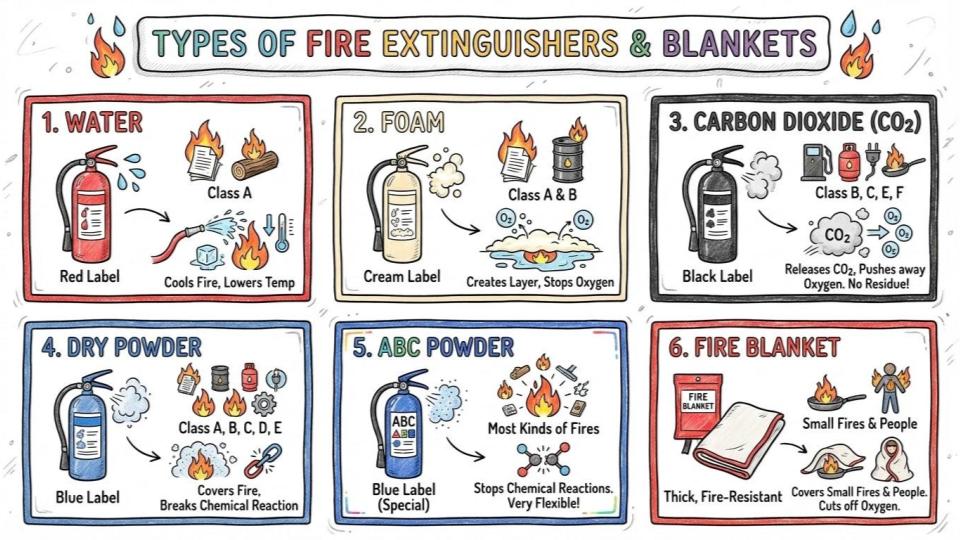
Water extinguishers: These fire extinguishers are easy to recognize because they have a red label. They are best used for fires that involve ordinary things like paper, wood, or cloth. These types of fires are called Class A fires. Water extinguishers work by cooling the fire and lowering the temperature so the flames go out.
Foam extinguishers: Foam extinguishers have a cream-colored label. They are useful for both Class A fires (like paper or cloth) and Class B fires, which include burning liquids such as petrol or oil. The foam creates a layer on top of the burning liquid, which stops oxygen from getting in and helps prevent the fire from starting again.
Carbon dioxide extinguishers: These are marked with a black label. They are used for many types of fires, including Class B (flammable liquids), Class C (flammable gases), Class E (electrical fires), and Class F (cooking oils and fats). They release a gas called carbon dioxide that pushes away the oxygen, stopping the fire. Since they don’t leave any messy residue, they are good for electrical fires too.
Dry powder extinguishers: These fire extinguishers have a blue label. They are very flexible and can be used on many types of fires, including Class A to E. They are especially useful for metal fires, which are known as Class D fires. The powder inside stops the fire by covering it and breaking the chemical reaction.
ABC powder extinguishers: These are a special kind of dry powder extinguisher that can handle most kinds of fires. The powder inside works by stopping the chemical reactions that keep a fire burning, making them good for many different situations.
Fire blanket: A fire blanket is made from a thick, fire-resistant material. It has two layers and is used to cover small fires, cutting off the oxygen supply and putting the fire out. It can also be wrapped around someone if their clothes are on fire to keep them safe and stop the flames.
Classes of Fire
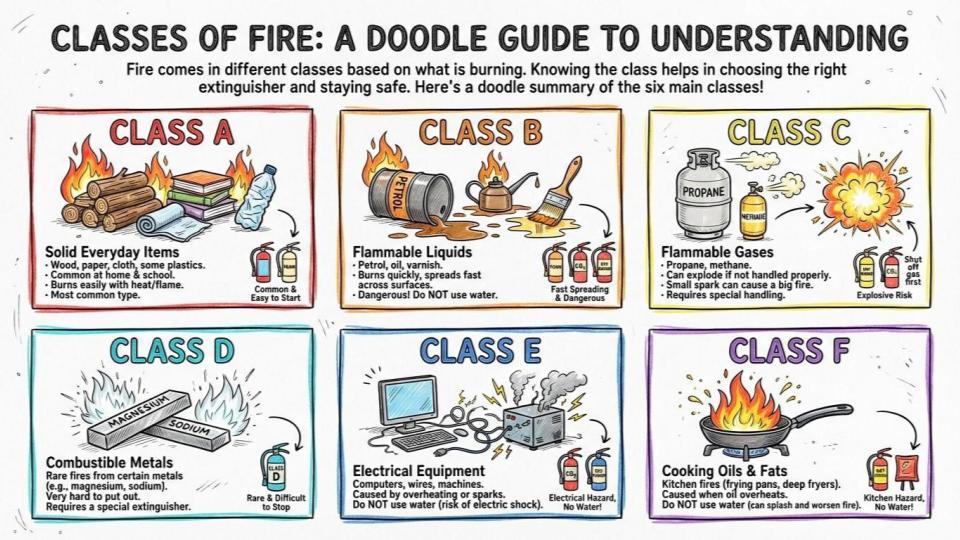
Class A: This kind of fire starts when solid everyday items like wood, paper, cloth, or even some plastics catch on fire. These materials are things we often use at home or school, and they can burn very easily when exposed to heat or flame. Because these items are all around us, Class A fires are the most common type we may see.
Class B: These fires happen when flammable liquids catch fire. Liquids such as petrol, oil, or varnish can burn very quickly and make flames spread fast. They are especially dangerous because they can run across surfaces and carry the fire with them. Water should not be used on these fires, because it can make the fire spread even more.
Class C: Class C fires are caused by flammable gases. Gases like propane and methane can burn and explode if not handled properly. These gases are often stored in special metal tanks, and if there is a leak and the gas mixes with air, a small spark can start a big fire. These fires are dangerous and require proper safety handling.
Class D: These fires come from certain types of metals catching fire, like magnesium or sodium. Not all metals can burn, but some special ones do, and when they do, the fire is very hard to put out. These metal fires are rare but very dangerous, and you must use a special fire extinguisher designed just for metal fires to stop them.
Class E: Class E fires are caused by electrical equipment such as computers, wires, or machines. If these items overheat or spark, they can start a fire. You must never use water to stop electrical fires because water conducts electricity, and it could give someone a dangerous electric shock. Special extinguishers that do not carry electricity must be used instead.
Class F: These fires usually happen in the kitchen, where people use cooking oils or fats. When the oil gets too hot, it can catch fire quickly. These fires are very hard to stop with normal water, and if you pour water on them, the fire can splash and become worse. That’s why kitchens should have a special fire extinguisher for oil fires.
How to Use a Fire Extinguisher (PASS Method)
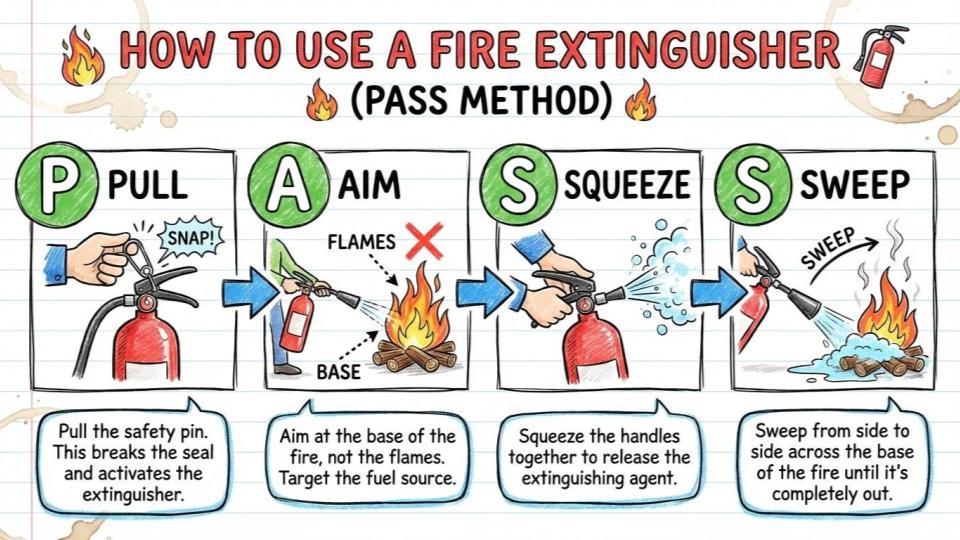
P – Pull: The very first step in using a fire extinguisher is to pull out the safety pin located at the top. This pin works like a safety lock to prevent anyone from accidentally pressing the handle and spraying the contents. When you pull it out, you are breaking a small plastic or metal seal. Once the seal is broken and the pin is removed, the extinguisher becomes active and ready to use in a real emergency to help put out a fire.
A – Aim: After pulling the pin, you need to aim the nozzle or the hose of the fire extinguisher. But where you aim is very important — don’t point it at the flames! Instead, aim at the base of the fire, which means the lowest part where the fire is actually touching the fuel or material that is burning. This is where the fire starts, and spraying there helps stop it from growing. If you aim at the flames only, the fire will likely keep burning.
S – Squeeze: Now that you’re aiming correctly, it’s time to squeeze the handles together. Use one hand to hold the handle at the top and the other hand to squeeze the trigger or lever underneath. When you do this, the extinguisher will release its chemical contents under pressure. This chemical is designed to cool the fire, remove oxygen, or stop the chemical reactions that are keeping the fire burning.
S – Sweep: The final step is to sweep the nozzle slowly from side to side across the base of the fire. Instead of spraying in just one spot, you move the spray back and forth in a wide motion to cover the entire area of burning material. This helps make sure that all parts of the fire are hit and cooled down so the flames can go out completely. If you only spray one part, the fire might still survive and start again, so sweeping is very important.
Auditing Fire Extinguishers
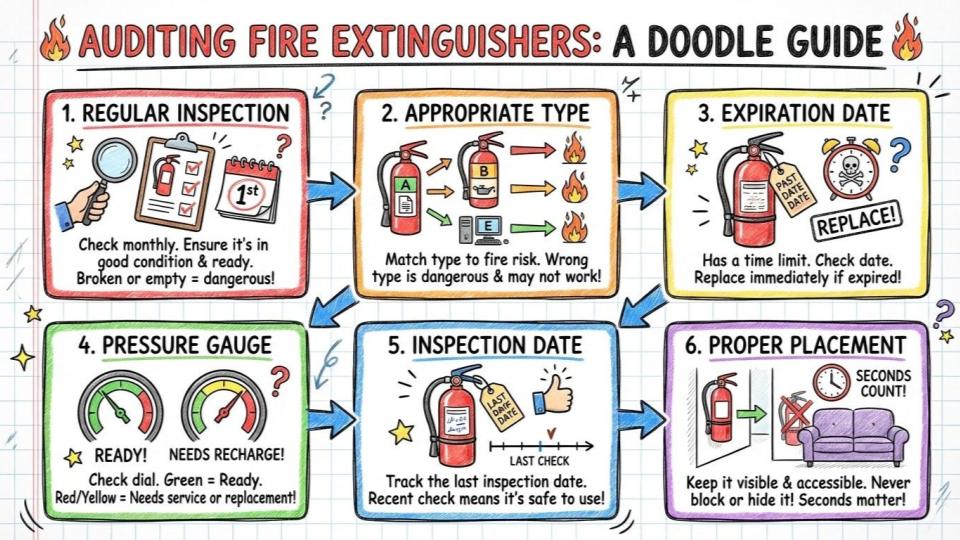
Regular inspection: Fire extinguishers should be checked regularly, such as once a month, to make sure they are in good condition and ready to use. If a fire extinguisher is broken, damaged, or empty, it won’t work during a fire, which can make a dangerous situation even worse. Regular inspections help make sure every extinguisher will work when needed.
Appropriate type: There are different types of fire extinguishers for different kinds of fires, such as ones for paper, oil, or electrical fires. It’s very important to have the correct type of extinguisher in each area. For example, kitchens should have extinguishers for cooking oil fires, while offices may need ones for electrical fires. Using the wrong type can be dangerous and might not stop the fire.
Expiration date: Fire extinguishers don’t last forever — they have a time limit. If a fire extinguisher is too old, the chemicals inside may not work properly or the pressure might have dropped. That’s why every extinguisher should be checked to make sure it hasn’t passed its expiration date. If it has, it should be replaced with a new one immediately.
Pressure gauge: Most fire extinguishers have a small round dial called a pressure gauge. This dial shows if the extinguisher has the right amount of pressure inside. If the needle on the gauge is pointing in the green zone, that means it’s ready to use. If it’s pointing in the red or yellow area, then it might not work, and it needs to be recharged or replaced.
Inspection date: Every fire extinguisher should have a tag or sticker that shows the last time it was inspected. This tells people whether it has been checked recently or not. If the date shows that it hasn’t been checked for a long time, then it might not be safe to use. Keeping track of inspection dates helps make sure extinguishers are always in good condition.
Proper placement: Fire extinguishers should always be placed in spots where people can easily see them and reach them quickly if there’s a fire. They should never be blocked by furniture, hidden behind doors, or locked away in hard-to-reach places. In an emergency, every second counts, so the extinguisher must be easy to find and grab.
Additional Safety Measures
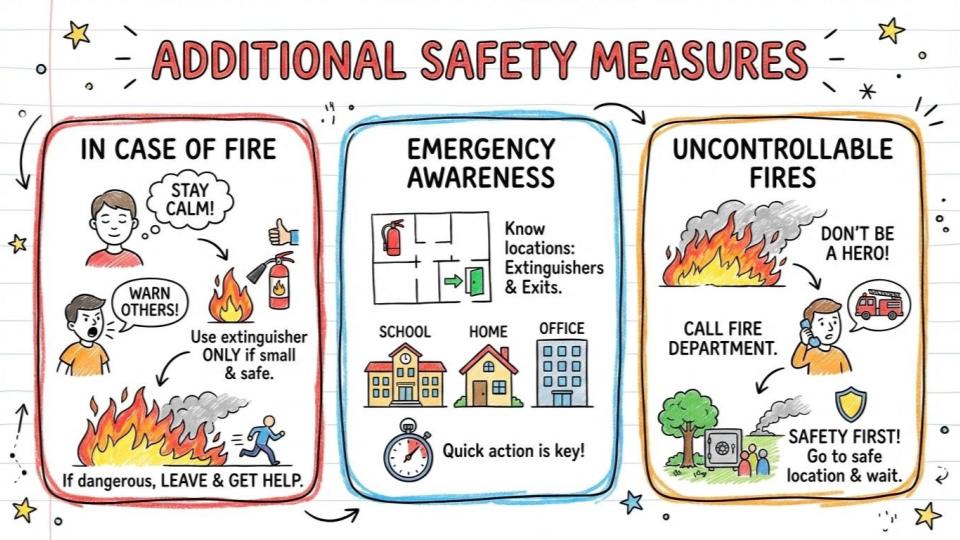
In case of fire: If there’s a fire, the most important thing to remember is to stay calm. Panicking can make it harder to think clearly or make smart decisions. You should also warn other people nearby right away so they can protect themselves. If the fire looks small and you feel confident, you can try to use a fire extinguisher — but only if you are completely sure that it’s safe and you know how to use it. If the fire is near something dangerous or seems to be growing, leave the area instead and get help.
Emergency awareness: It’s really important that everyone in a building — whether it’s a school, home, or office — knows exactly where the fire extinguishers and emergency exits are. That way, if a fire starts, you won’t waste time trying to figure out where to go or what to use. Quick action is super important during a fire, and knowing your surroundings helps you get to safety faster and possibly help others too.
Uncontrollable fires: Sometimes, fires can get too big, too fast. If the fire is spreading quickly or looks too dangerous, don’t try to be a hero. It’s not safe to handle a large fire by yourself. Instead, you should immediately call the fire department and leave the building. Make sure you go to a safe location, away from the fire and smoke, and wait for the firefighters to arrive and take control of the situation. Your safety always comes first.
Creating a Simple Fire Extinguisher
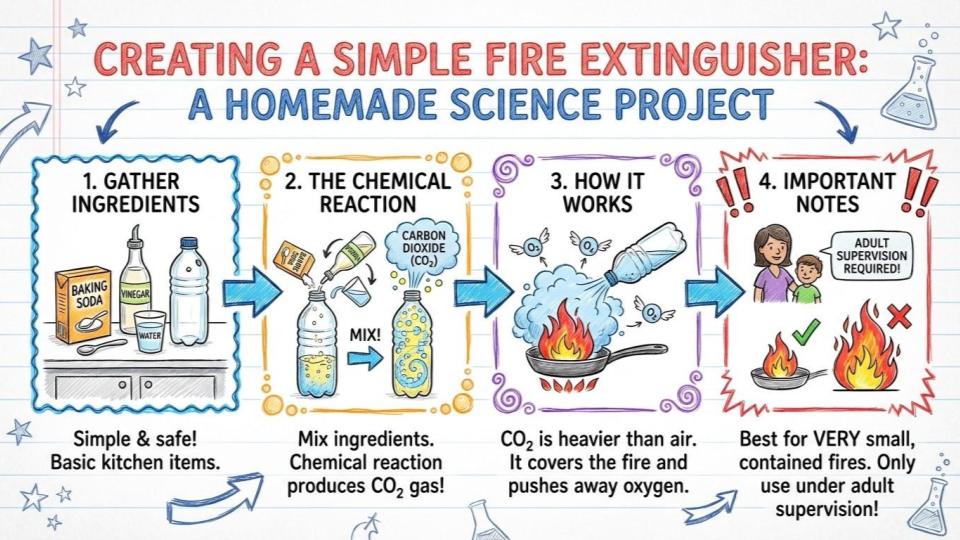
Homemade extinguisher: It is possible to make a simple and safe mini fire extinguisher at home using basic kitchen items such as baking soda, vinegar, and a little water. When you mix these ingredients together, a chemical reaction happens. This reaction produces a gas called carbon dioxide (CO₂). Carbon dioxide is heavier than air, and when it is released over a small fire, it can cover the fire and push away the oxygen that the fire needs to keep burning. Without oxygen, the fire can no longer survive and will go out. This method works best for very small, contained fires and should only be used under adult supervision.
Fire Triangle – Requirements for Fire
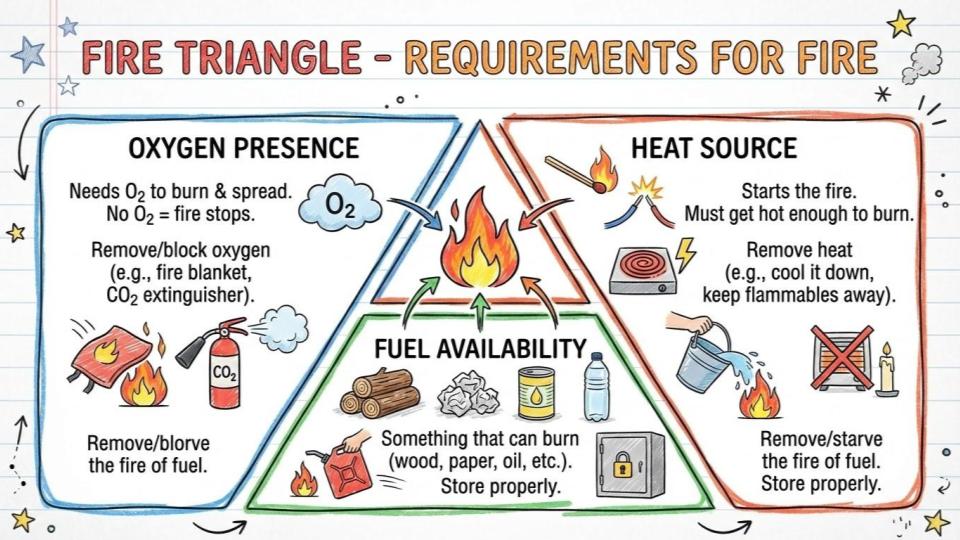
Oxygen presence: Every fire needs oxygen to stay alive and keep burning. Oxygen is one of the main components in the air that we breathe. It helps the flames grow and spread. If there is no oxygen, the fire will not be able to continue. That’s why one of the ways to put out a fire is to remove or block the oxygen from reaching it. For example, covering a fire with a fire blanket or using a carbon dioxide extinguisher can cut off the oxygen and stop the flames.
Heat source: Another thing a fire needs is heat — this is what starts the fire in the first place. Heat can come from a spark, flame, hot surface, or lightning. Once a material gets hot enough, it catches fire and begins to burn. Without enough heat, even if oxygen and fuel are present, a fire cannot start. That’s why it’s important to keep flammable items away from heaters, candles, or anything that gets very hot.
Fuel availability: Finally, a fire must have fuel, which means there must be something available that can burn. Fuels include items like wood, paper, cooking oil, gasoline, and plastic. These are the materials that actually catch fire and keep it going. Without fuel, the fire has nothing to consume and it will eventually die out. This is why fire safety includes storing fuels properly and keeping them away from heat sources and open flames.
Suitable Extinguishers by Fire Class
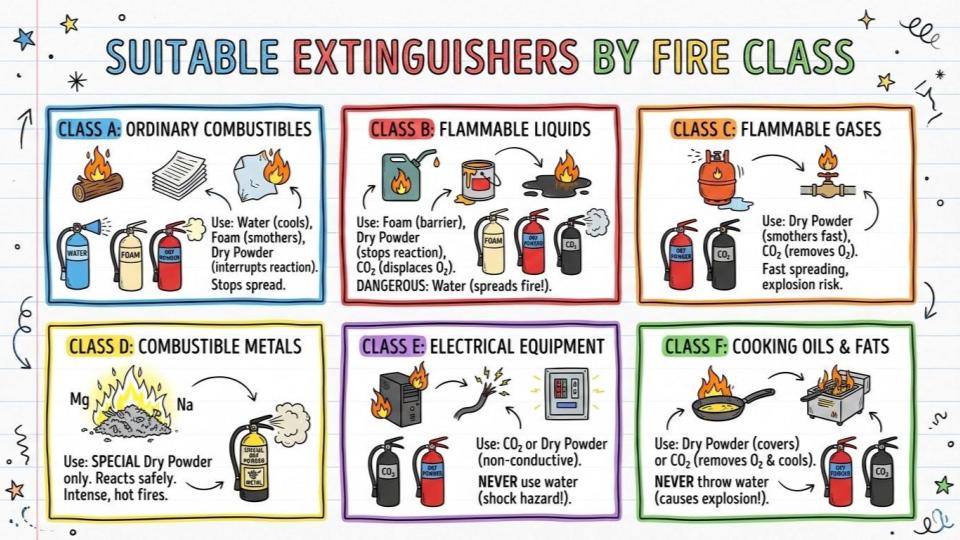
Class A: These fires involve materials like wood, paper, cloth, and some plastics — all things that are part of our daily lives. To put out Class A fires, you can use water extinguishers, which help cool down the burning items and stop the fire. Foam extinguishers are also effective because they cover the burning surface and prevent oxygen from reaching the fire. Another good option is the dry powder extinguisher, which interrupts the fire’s chemical reaction and puts it out quickly. Using the correct extinguisher can prevent the fire from spreading to other nearby objects.
Class B: These fires are caused by flammable liquids like petrol, paint, or oil. Using water can be dangerous for these fires because the liquids float on water and may spread the fire further. The safest choices are foam extinguishers, which create a barrier over the liquid surface to cut off oxygen, dry powder extinguishers, which stop the chemical reactions that feed the fire, and carbon dioxide (CO₂) extinguishers, which replace the oxygen around the fire with CO₂ gas, making it impossible for the fire to keep burning.
Class C: These fires involve gases like propane, butane, or methane. Gas fires can be very dangerous because gas spreads quickly and can cause explosions. The best way to stop a gas fire is with a dry powder extinguisher, which acts fast to smother the flames and stop the gas from continuing to burn. You can also use carbon dioxide extinguishers, which remove the oxygen that fuels the fire. These extinguishers work without leaving behind any water or foam, which is important when dealing with gases.
Class D: Metal fires are very unusual and can happen when certain metals like magnesium, potassium, or sodium catch fire. These fires are very intense and hot, and they need special treatment. You should only use a dry powder extinguisher made specifically for metal fires. These extinguishers contain powders that react safely with the burning metal and help put out the flames without causing a chemical reaction that could make the fire worse.
Class E: Electrical fires start when devices like wires, computers, or electrical machines catch fire. Water must never be used, as it conducts electricity and can cause electric shock. Instead, use a carbon dioxide extinguisher, which doesn’t conduct electricity and also won’t leave a mess behind. A dry powder extinguisher is also safe because it doesn’t let electricity flow through it. Both types can quickly cut off the fire’s ability to continue without endangering the person using them.
Class F: These fires are often found in kitchens and involve very hot cooking oils and fats. If water is thrown on these fires, it can cause the oil to splatter and create an explosion of fire. The correct way to handle these dangerous fires is to use a dry powder extinguisher, which covers the fire and stops oxygen from reaching it, or a carbon dioxide extinguisher, which removes oxygen and cools the fire. These extinguishers are specially designed for high-temperature fires like those that happen in deep fryers or cooking pots.