16.1 Organisation of Plant Tissues
Organisation of Plant Tissues
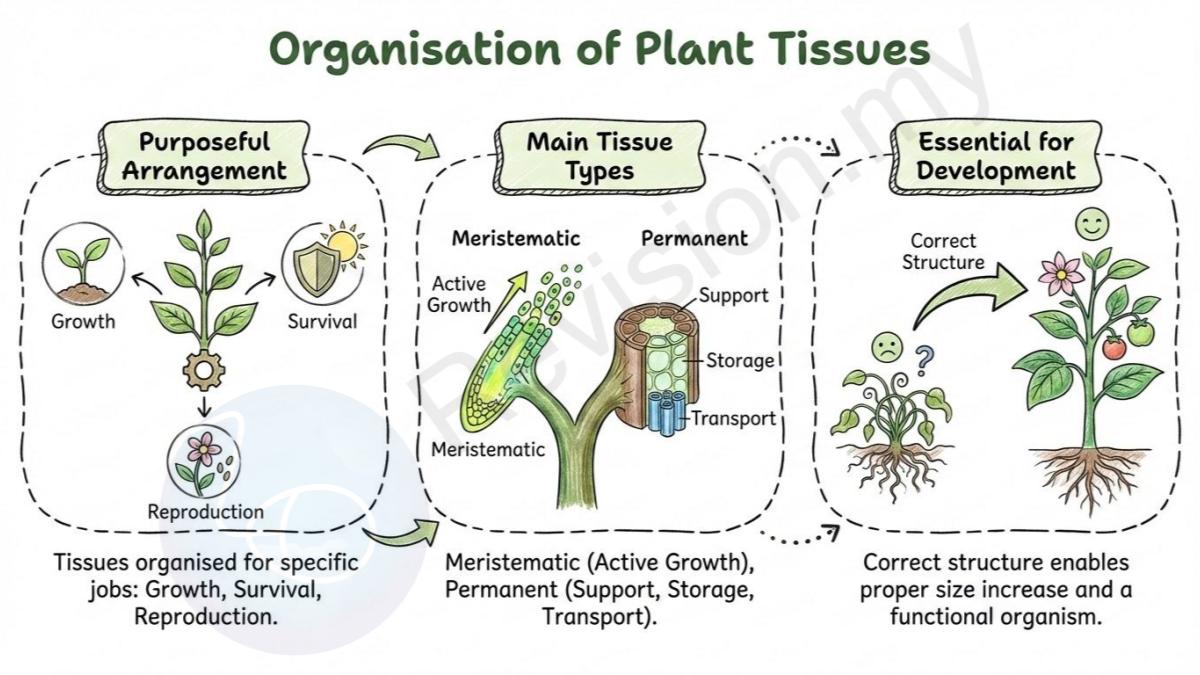
Functional tissue organisation: In plants, different tissues are arranged and organised in specific ways so that each type of tissue can perform a particular job. This organisation helps the plant carry out all the processes it needs to grow, survive, and reproduce.
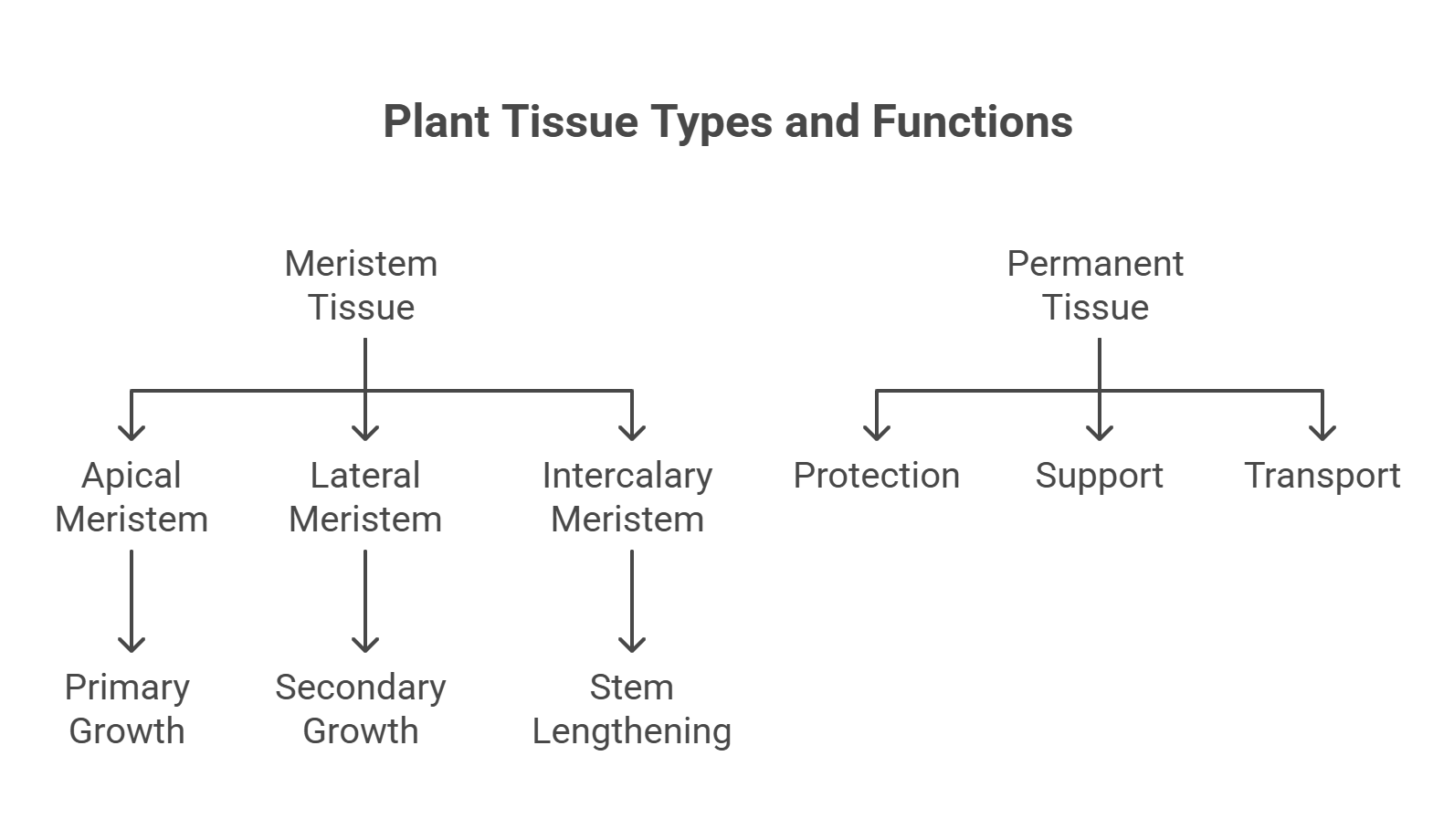
Main tissue categories: Plant tissues are grouped into two main types based on their roles and characteristics. These are meristematic tissues, which are involved in growth, and permanent tissues, which carry out other essential functions like support, storage, and transport.
Growth contribution: The correct organisation and arrangement of tissues in a plant help it grow in size and develop into a healthy and functional organism. Without this structure, the plant would not be able to grow properly.
Types of Plant Tissue
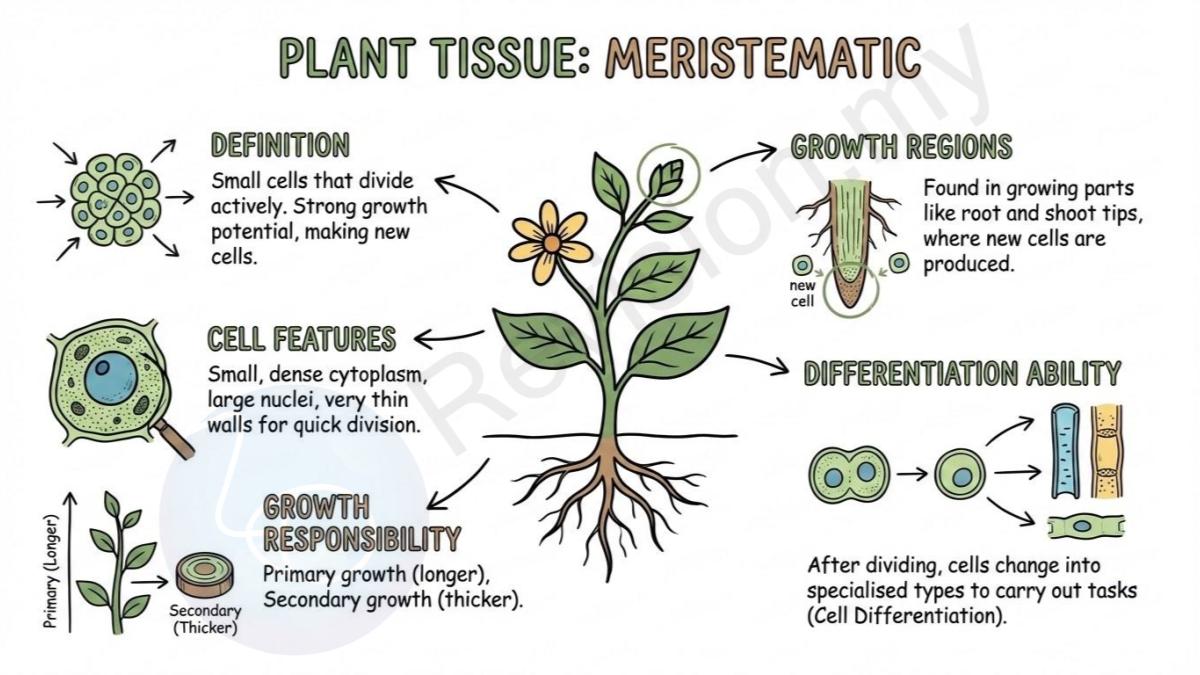
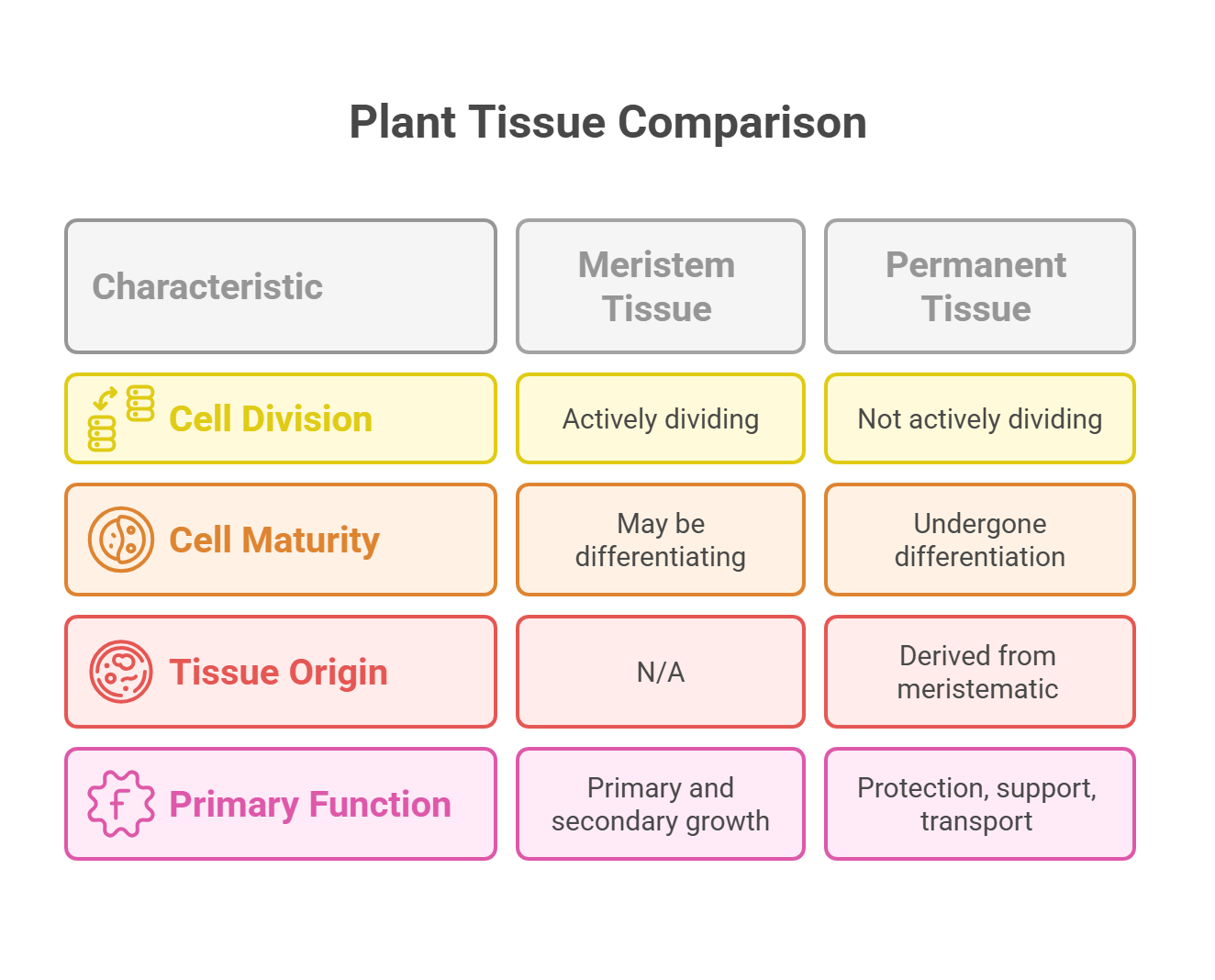
Meristem tissue definition: Meristematic tissue is made up of very small cells that keep dividing actively. These cells have a strong potential for growth and are responsible for making new cells in the plant.
Cell features: The cells in meristematic tissue are small and have a dense cytoplasm. They also contain large nuclei and have very thin walls, which helps them to divide quickly and form new tissues.
Growth regions: Meristematic tissues are found in parts of the plant that are still growing, like the tips of the roots and shoots. These areas are where most of the new cells are produced.
Differentiation ability: After dividing, the cells from the meristematic tissue can change into different types of cells that carry out special tasks. This process is known as cell differentiation.
Growth responsibility: Meristematic tissues are mainly responsible for two types of plant growth: primary growth (making the plant longer) and secondary growth (making the plant thicker).
Types of Meristematic Tissue
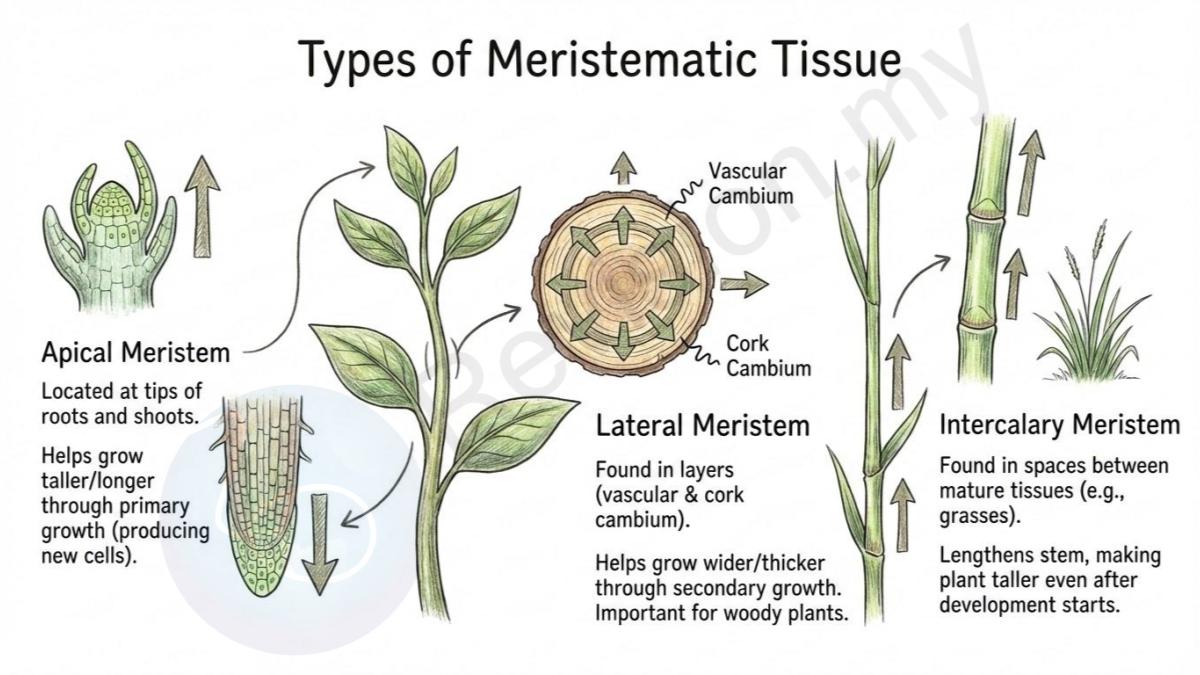
Apical meristem: This type of meristem is located at the very tips of the plant’s roots and shoots. It helps the plant grow taller or longer by producing new cells through a process called primary growth.
Lateral meristem: This type is found in layers like the vascular cambium and cork cambium. It helps the plant grow wider or thicker, which is called secondary growth. This is important for woody plants.
Intercalary meristem: This type is found in the spaces between mature tissues, especially in plants like grasses (monocots). It helps in lengthening the stem and making the plant taller even after the plant has started developing other structures.
Permanent Tissue
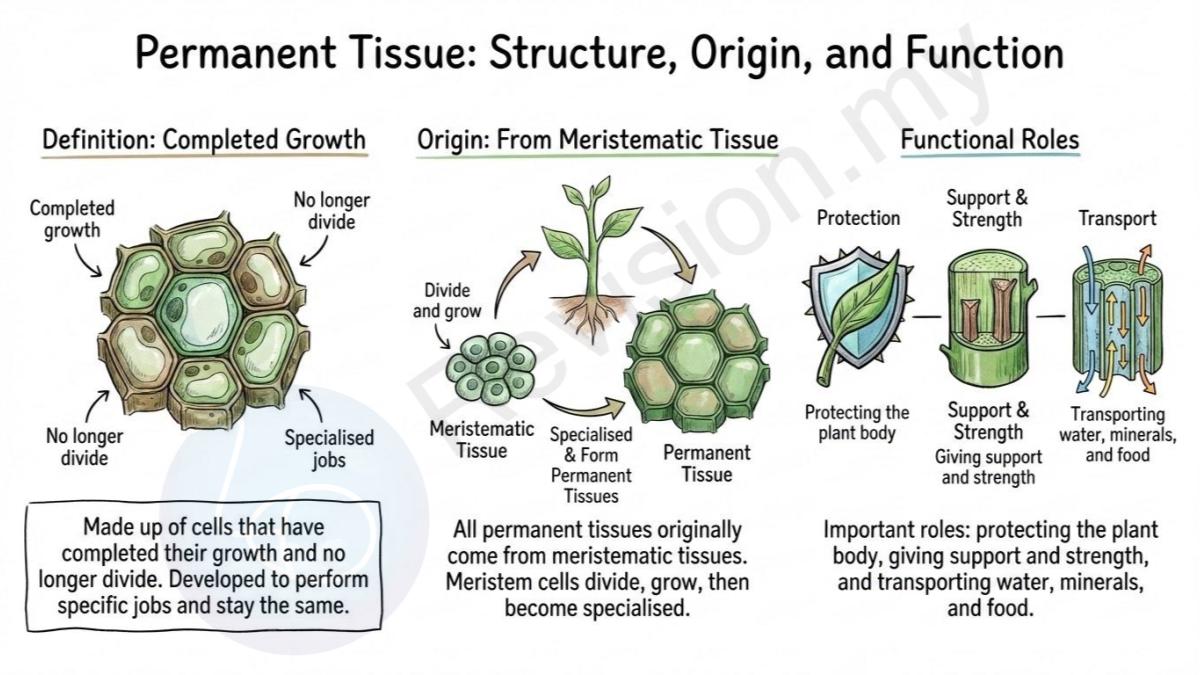
Permanent tissue definition: Permanent tissues are made up of cells that have completed their growth and no longer divide. These cells have developed to perform specific jobs and usually stay the same throughout the life of the plant.
Meristem origin: All permanent tissues originally come from meristematic tissues. After the meristem cells divide and grow, they become specialised and form permanent tissues.
Functional roles: Permanent tissues have important roles in the plant such as protecting the plant body, giving support and strength, and transporting water, minerals, and food.
Types of Permanent Tissue
Epidermal Tissue
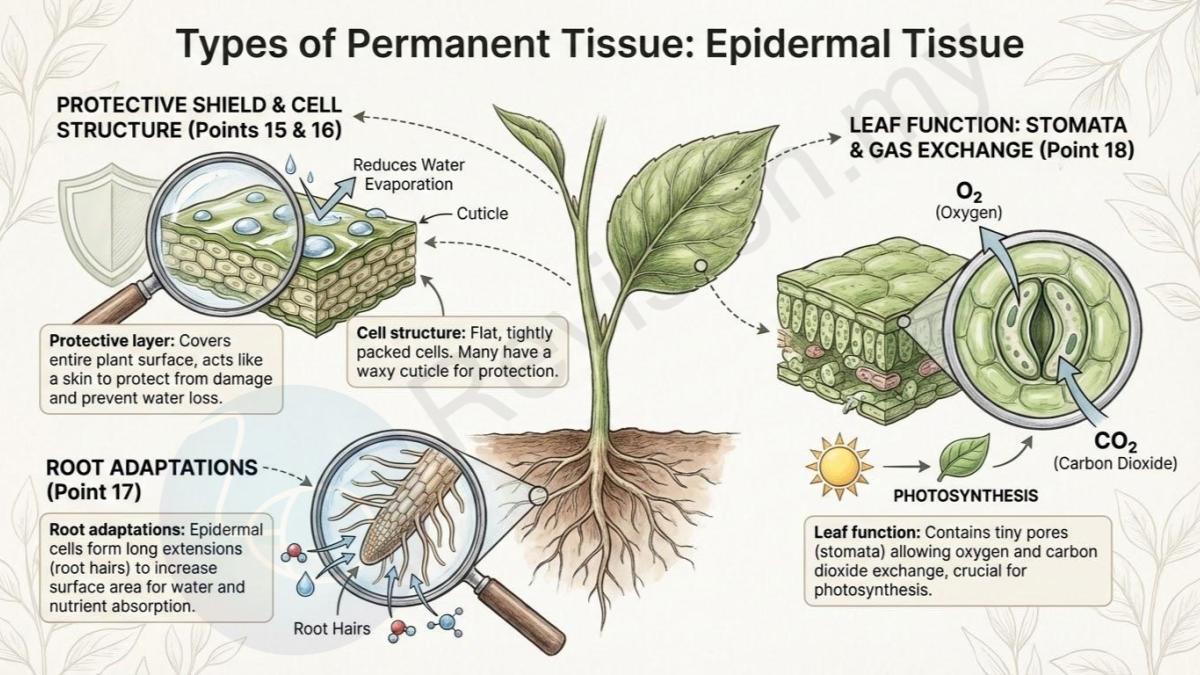
Protective layer: This tissue forms a protective outer layer that covers the entire surface of the plant. It acts like a skin that protects the plant from damage and helps prevent water loss.
Cell structure: The cells in the epidermis are flat and tightly packed together. Many have a waxy coating on their surface called the cuticle, which reduces water evaporation and protects the plant.
Root adaptations: In roots, the epidermal cells can grow long extensions called root hairs. These root hairs increase the surface area of the root and help the plant absorb more water and nutrients from the soil.
Leaf function: In leaves, the epidermis contains tiny pores called stomata. These pores allow gases like oxygen and carbon dioxide to move in and out of the leaf, which is important for photosynthesis.
Ground Tissue
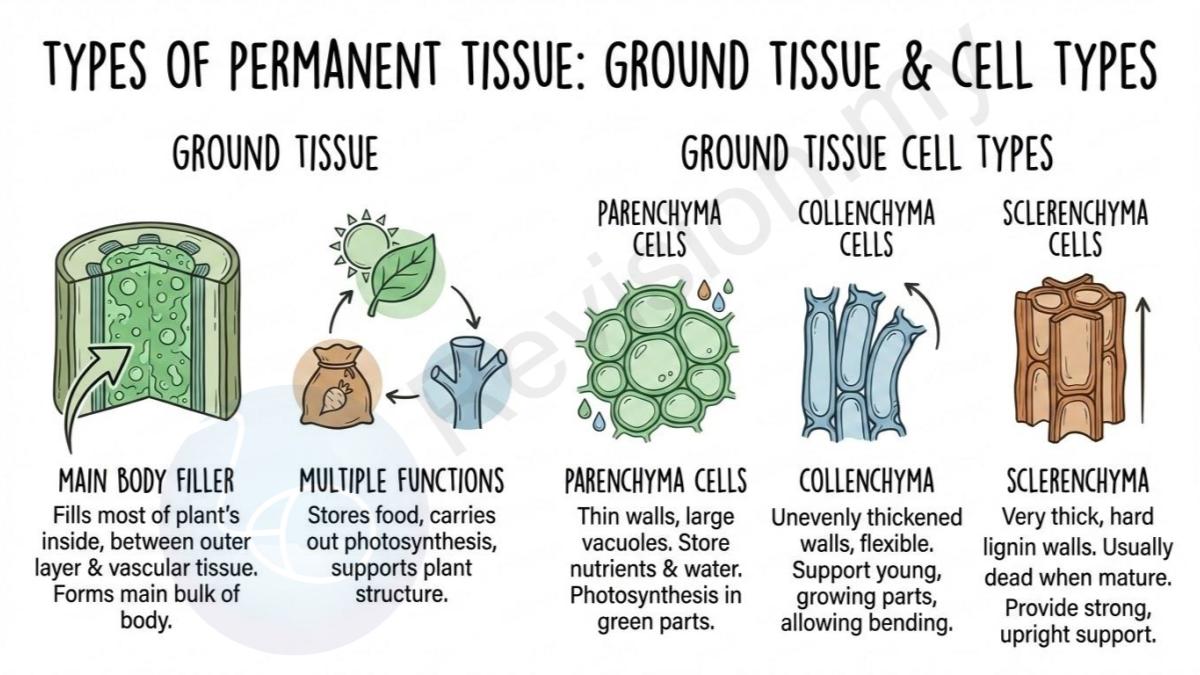
Main body filler: Ground tissue makes up most of the inside of a plant. It fills up the space between the outer layer and the vascular tissues and forms the main bulk of the plant body.
Multiple functions: This tissue helps with many different tasks such as storing food, carrying out photosynthesis, and supporting the plant’s structure.
Ground Tissue Cell Types
Parenchyma cells: These are basic plant cells with thin walls and large spaces inside them (vacuoles). They help store nutrients and water, and they also carry out photosynthesis in the green parts of the plant.
Collenchyma cells: These cells have unevenly thickened walls and are flexible. They give support to young and growing parts of the plant, such as stems and leaves, while still allowing them to bend and stretch.
Sclerenchyma cells: These cells have very thick, hard walls made of a substance called lignin. They are usually dead when mature but provide strong support and help the plant stay upright.
Vascular Tissue
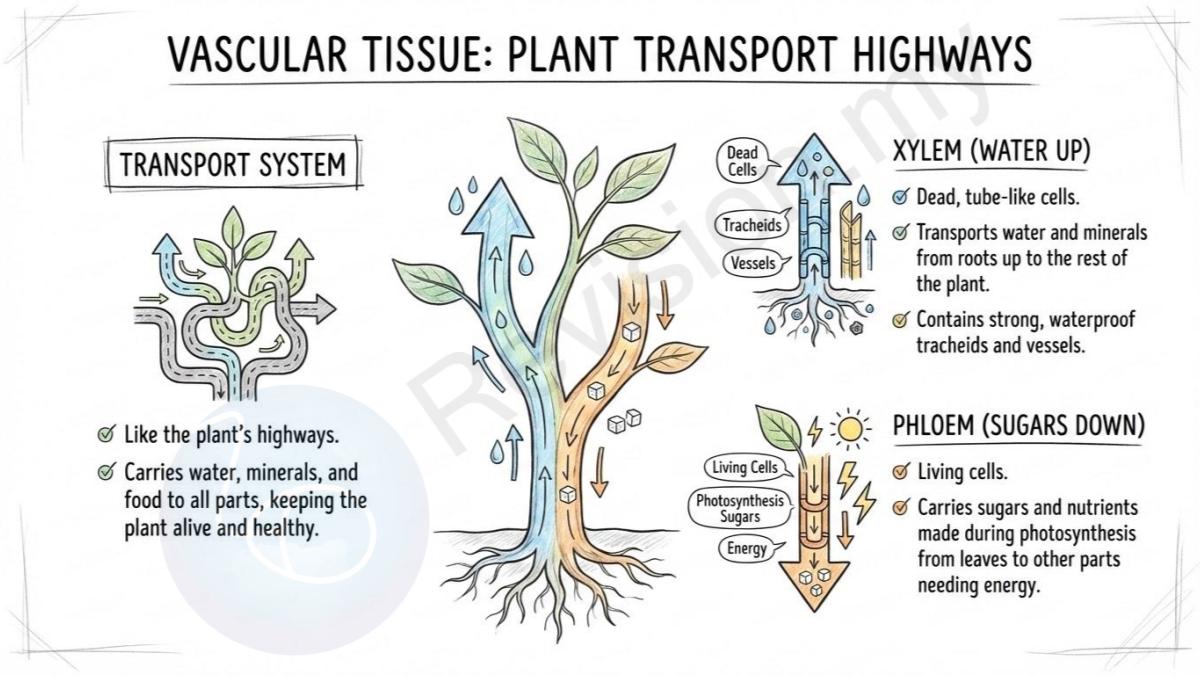
Transport system: Vascular tissues are like the plant’s transport highways. They carry water, minerals, and food to all parts of the plant to keep it alive and healthy.
Xylem function: Xylem tissue is made of dead, tube-like cells that transport water and minerals from the roots up to the rest of the plant. It contains tracheids and vessels which are strong and waterproof.
Phloem function: Phloem tissue is made of living cells that carry sugars and nutrients made during photosynthesis from the leaves to other parts of the plant that need energy.
Plant Growth and Development
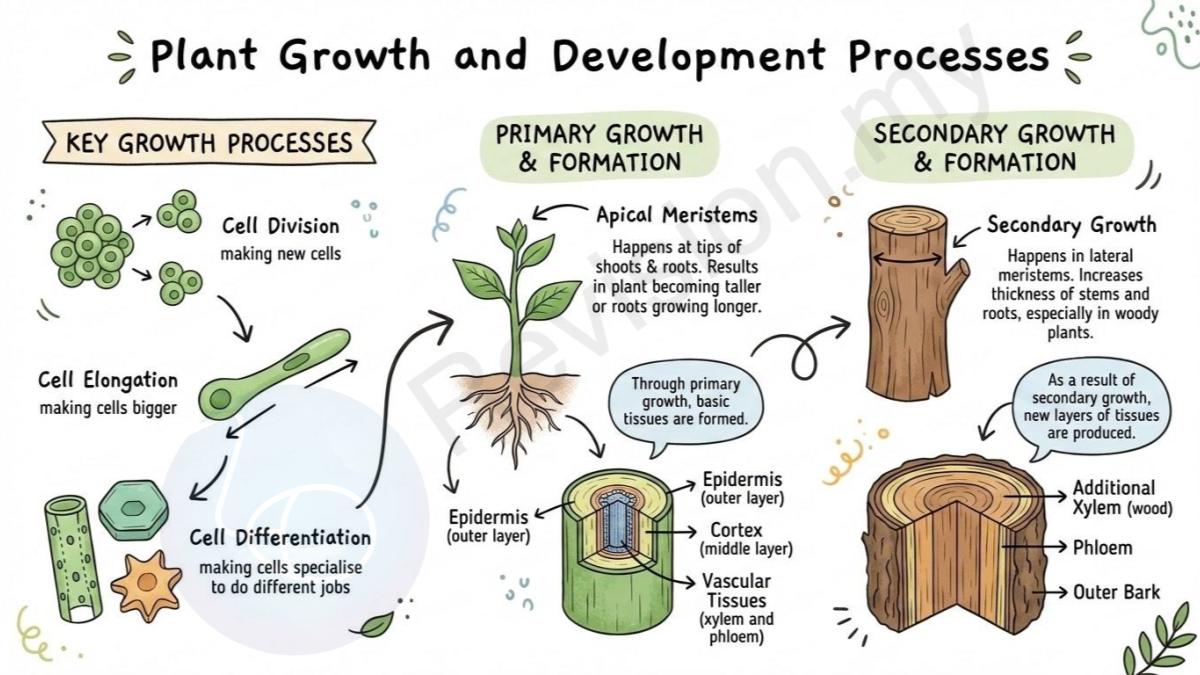
Growth processes: Plant growth involves three key processes: cell division (making new cells), cell elongation (making cells bigger), and cell differentiation (making cells specialise to do different jobs).
Primary growth: This happens at the apical meristems (tips of shoots and roots) and results in the plant becoming taller or the roots growing longer.
Primary tissue formation: Through primary growth, basic tissues such as the epidermis (outer layer), cortex (middle layer), and vascular tissues (xylem and phloem) are formed.
Secondary growth: This type of growth happens in the lateral meristems and increases the thickness of stems and roots, especially in woody plants.
Secondary tissue formation: As a result of secondary growth, new layers of tissues are produced such as additional xylem (wood), phloem, and the outer bark.
Zones of Cell Growth
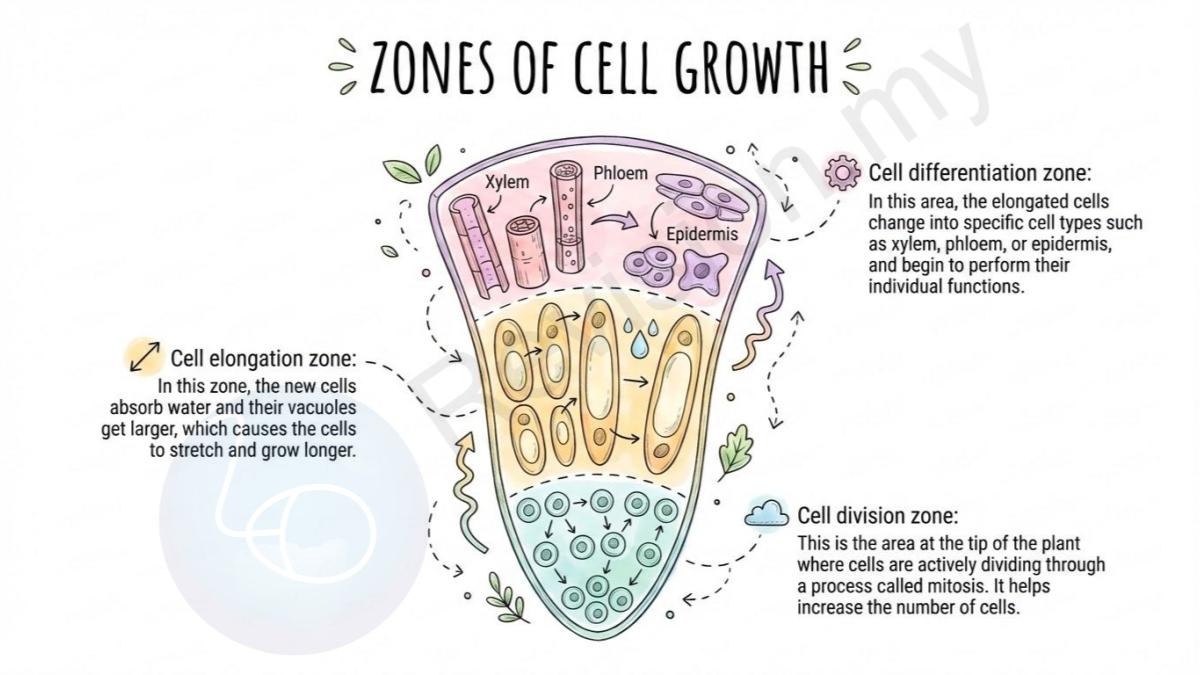
Cell division zone: This is the area at the tip of the plant where cells are actively dividing through a process called mitosis. It helps increase the number of cells.
Cell elongation zone: In this zone, the new cells absorb water and their vacuoles get larger, which causes the cells to stretch and grow longer.
Cell differentiation zone: In this area, the elongated cells change into specific cell types such as xylem, phloem, or epidermis, and begin to perform their individual functions.
Types of Plant Growth Based on Life Cycle
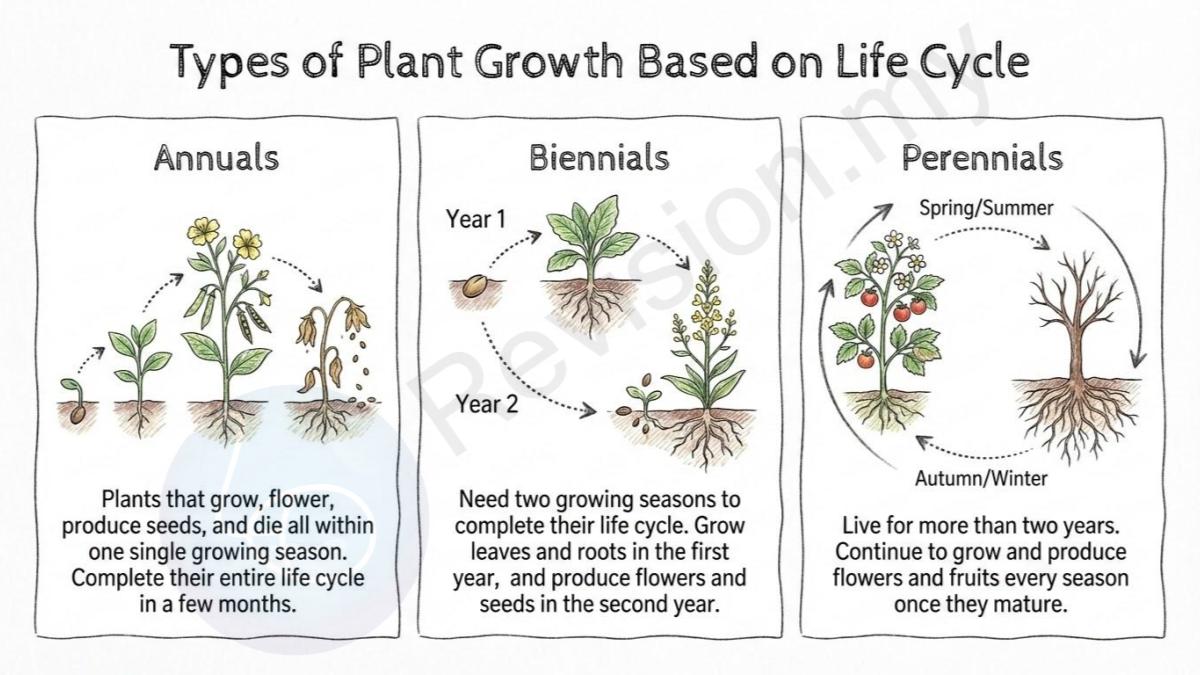
Annuals: These are plants that grow, flower, produce seeds, and die all within one single growing season. They complete their entire life cycle in a few months.
Biennials: These plants need two growing seasons to complete their life cycle. Usually, they grow leaves and roots in the first year, and in the second year, they produce flowers and seeds.
Perennials: These plants live for more than two years. They continue to grow and produce flowers and fruits every season once they mature.
Growth Curves
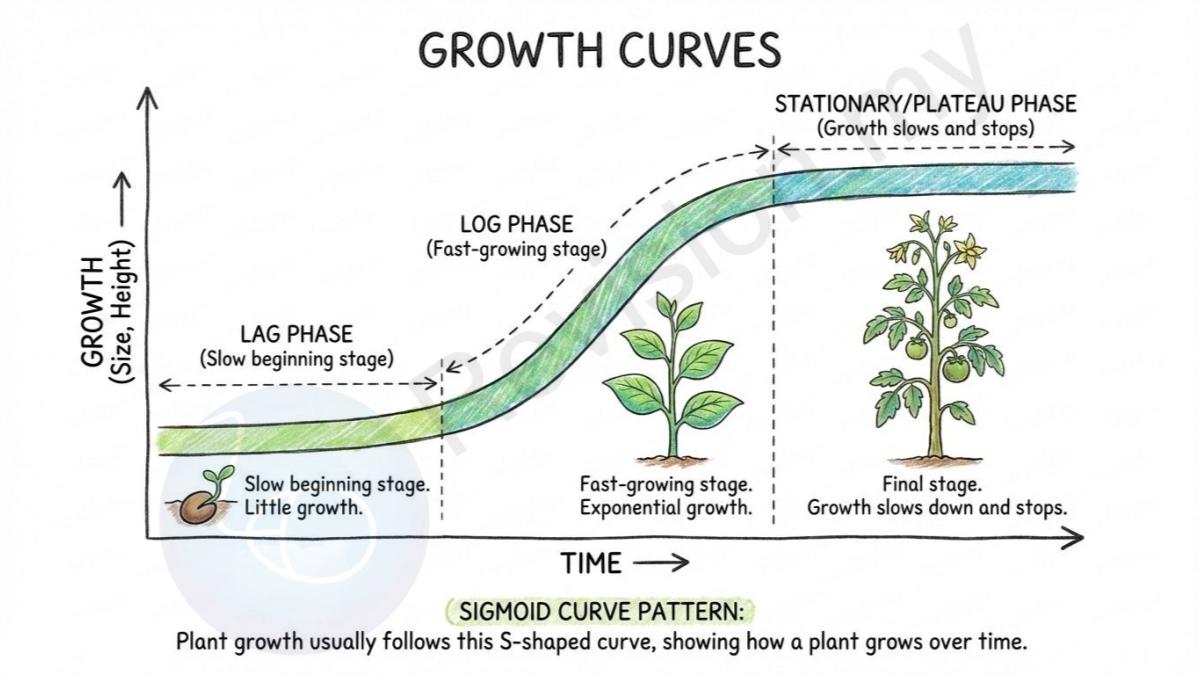
Sigmoid curve pattern: Plant growth usually follows an S-shaped curve called a sigmoid curve. This curve shows how a plant grows over time.
Growth stages in curve: The sigmoid curve has three stages: a slow beginning stage (lag phase), a fast-growing stage (log phase), and a final stage where growth slows down and stops (stationary or plateau phase).
Factors Affecting Growth
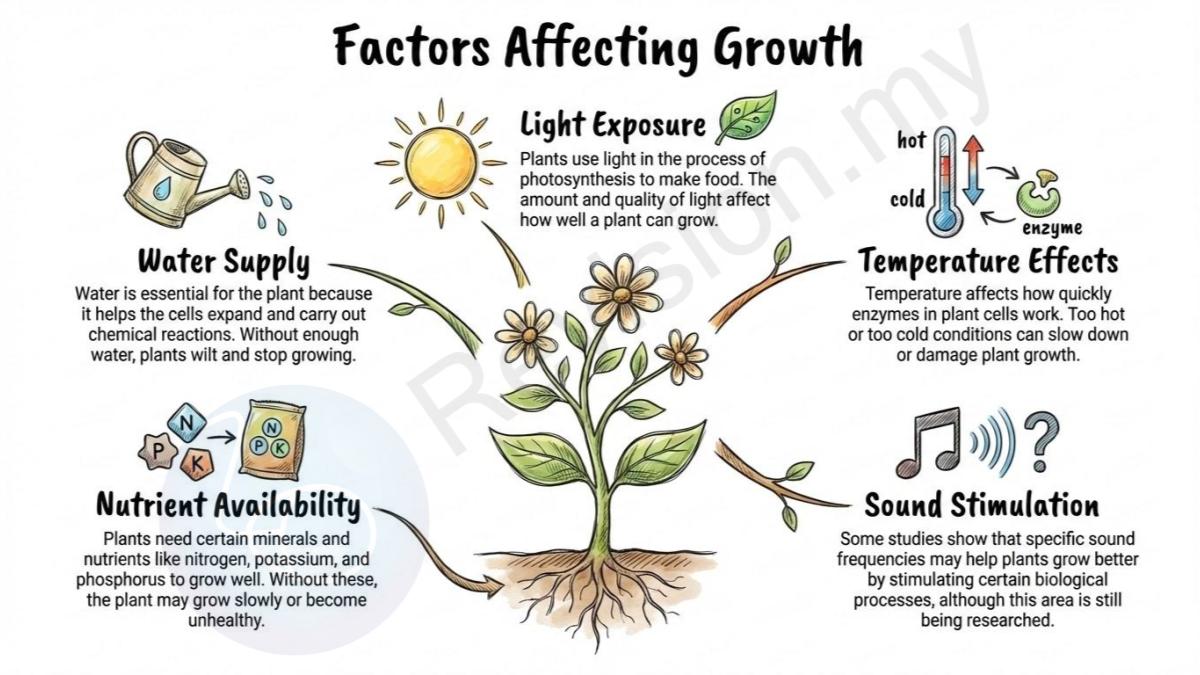
Nutrient availability: Plants need certain minerals and nutrients like nitrogen, potassium, and phosphorus to grow well. Without these, the plant may grow slowly or become unhealthy.
Water supply: Water is essential for the plant because it helps the cells expand and carry out chemical reactions. Without enough water, plants wilt and stop growing.
Light exposure: Plants use light in the process of photosynthesis to make food. The amount and quality of light affect how well a plant can grow.
Temperature effects: Temperature affects how quickly enzymes in plant cells work. Too hot or too cold conditions can slow down or damage plant growth.
Sound stimulation: Some studies show that specific sound frequencies may help plants grow better by stimulating certain biological processes, although this area is still being researched.