2.1 Basic Concepts of Matter
Basic Concept of Matter
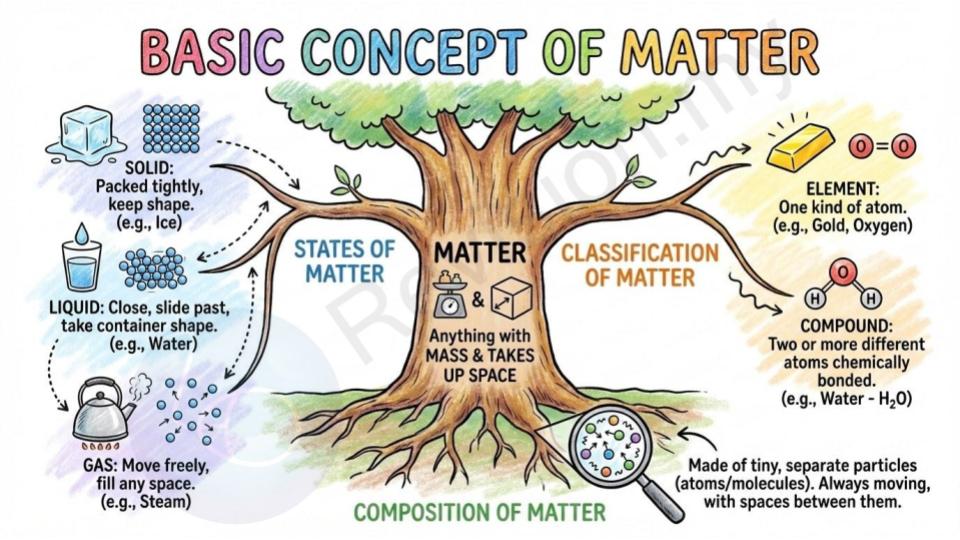
Definition of matter:
- Matter is everything around us that has mass, which means it weighs something, and takes up space.
- This means that if an object, like a book, air, or water, has weight and fills up any part of the world, it is called matter.
- Even things we cannot see, like the air we breathe, still matter because they have tiny particles that add weight and take up space.
States of matter:
- Matter can be found in three main physical states, which are solid, liquid, or gas.
- These are the different forms that matter can take, and they depend on how the tiny particles inside behave and how much energy they have.
- For example, in solids like ice, the particles are packed tightly and don’t move around much, so solids keep their shape.
- In liquids like water, the particles are close together but can slide past each other, so liquids flow and take the shape of their container.
- In gases like steam, the particles move freely and spread out to fill any space.
Classification of matter: We can sort matter into two main groups called elements and compounds.
Definition of element: An element is a pure substance that is made up of only one type of atom. Examples include gold, oxygen, and hydrogen.
Definition of compound: A compound is a substance formed when atoms of different elements are chemically combined. Water (H₂O) is a compound made from hydrogen and oxygen.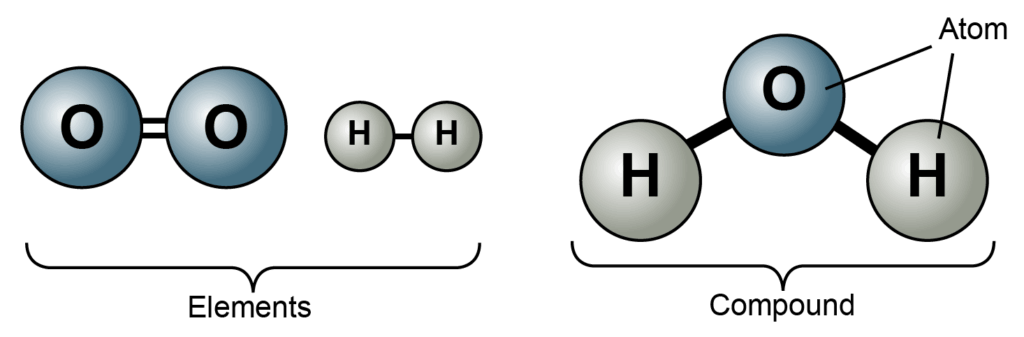
Composition of matter: All matter is made up of extremely tiny particles called atoms or molecules. These particles are so small that we cannot see them without special scientific tools like powerful microscopes. These tiny particles are always moving around, even in solids, and they are not stuck together in one big clump. The spaces between the particles and how they move help decide if the matter is a solid, liquid, or gas.
Particles
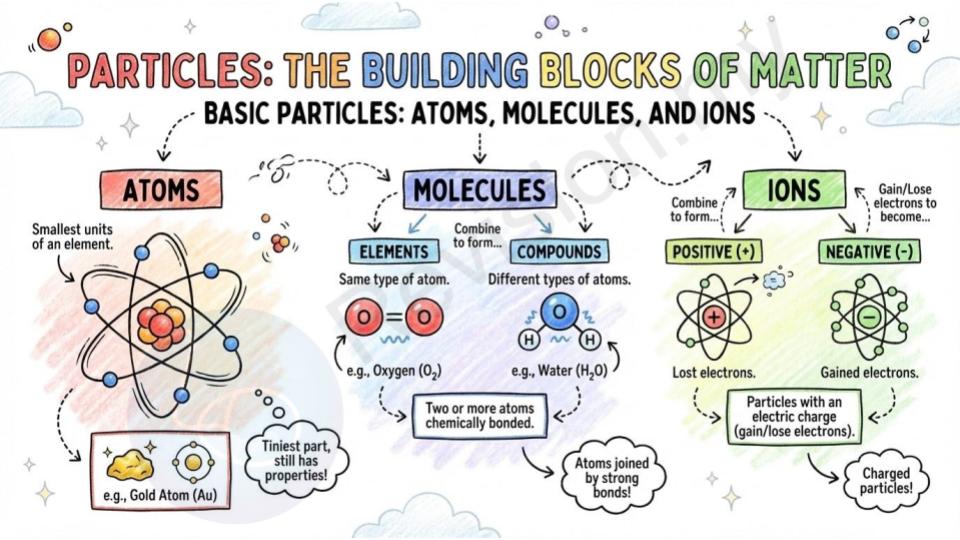
Types of particles: The smallest building blocks of matter are called atoms, molecules, and ions. These are like the tiny LEGO blocks that make up everything around us.
Atoms: Atoms are the tiniest part of an element that still has the properties of that element. For example, a gold atom is the smallest bit of gold you can have.
Molecules: Molecules are made when two or more atoms are joined together by chemical bonds. These bonds hold the atoms together tightly.
Types of molecules: Molecules can be simple, made from only one kind of atom like oxygen (O₂), or complex, made from different types of atoms like water (H₂O).
Ions: Ions are particles that have an electric charge. They are formed when atoms gain or lose electrons. A positive ion has lost electrons, while a negative ion has gained electrons.
States of Matter
Solid
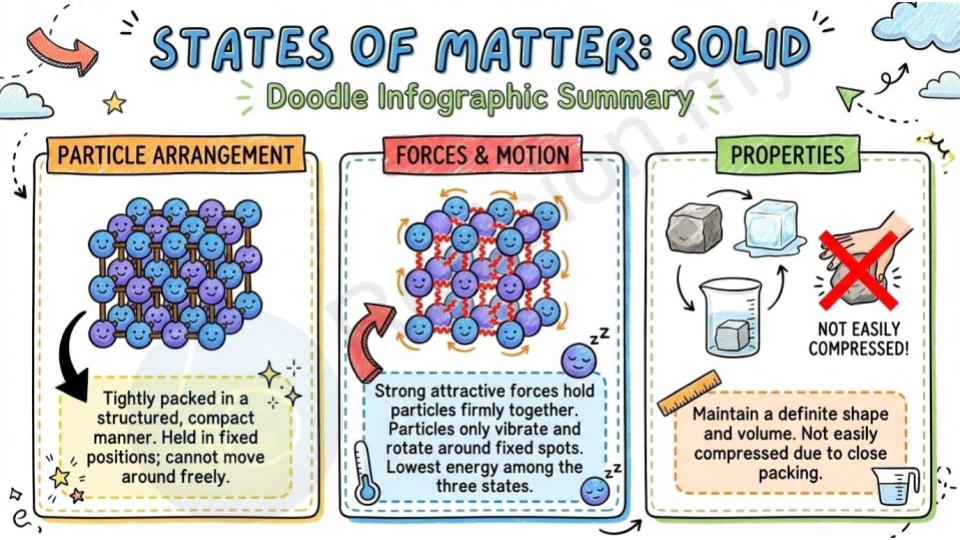
Particle arrangement in solids: In solids, the particles are packed very tightly in a neat and regular pattern. They are held in place and can’t move around much.
Forces in solids: The particles in a solid are held together by very strong forces of attraction, which is why solids keep their shape.
Motion in solids: Even though the particles in a solid can’t move freely, they still vibrate and slightly rotate in their fixed positions.
Properties of solids: Solids always have their own shape and volume. They do not change shape unless you cut or break them.
Compressibility of solids: Solids cannot be squashed easily because their particles are already packed closely together.
Energy in solids: Among all three states of matter, solids have the least amount of energy because their particles move the least.
Liquid
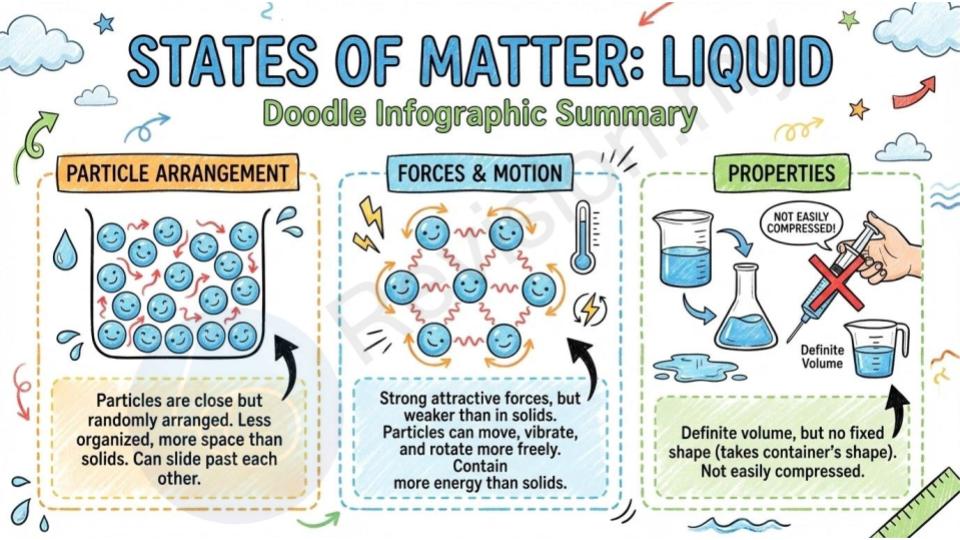
Particle arrangement in liquids: In liquids, the particles are close to each other but not as tightly packed as in solids. They are more randomly arranged.
Forces in liquids: The particles in liquids still attract each other, but the forces are weaker than in solids, allowing them to move around more.
Motion in liquids: Liquid particles can slide past one another, and they can vibrate, rotate, and move around within the liquid.
Properties of liquids: Liquids have a fixed volume but they take the shape of the container they are in.
Compressibility of liquids: Liquids are not easily squashed because their particles are still fairly close together.
Energy in liquids: Particles in liquids have more energy than those in solids, which is why they can move around more.
Gas
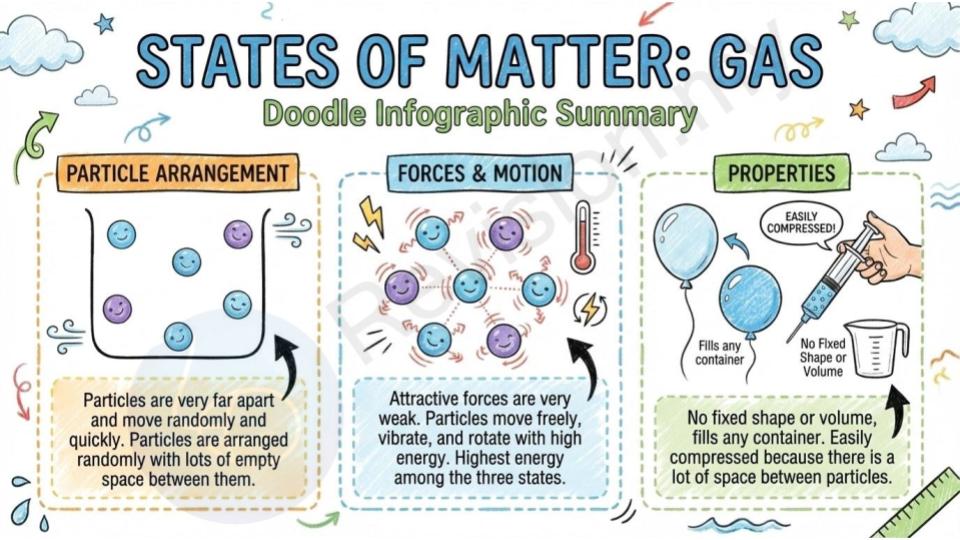
Particle arrangement in gases: Gas particles are spread out very far apart and are arranged randomly with lots of empty space between them.
Forces in gases: The forces of attraction between gas particles are extremely weak, which is why they don’t stay close together.
Motion in gases: Gas particles move around very quickly in all directions. They can vibrate, rotate, and travel freely.
Properties of gases: Gases do not have a fixed shape or volume. They spread out to fill any container they are placed in.
Compressibility of gases: Gases can be compressed easily because there is a lot of space between their particles.
Energy in gases: Gases have the highest energy among the three states because their particles move the fastest.
Changes in States of Matter
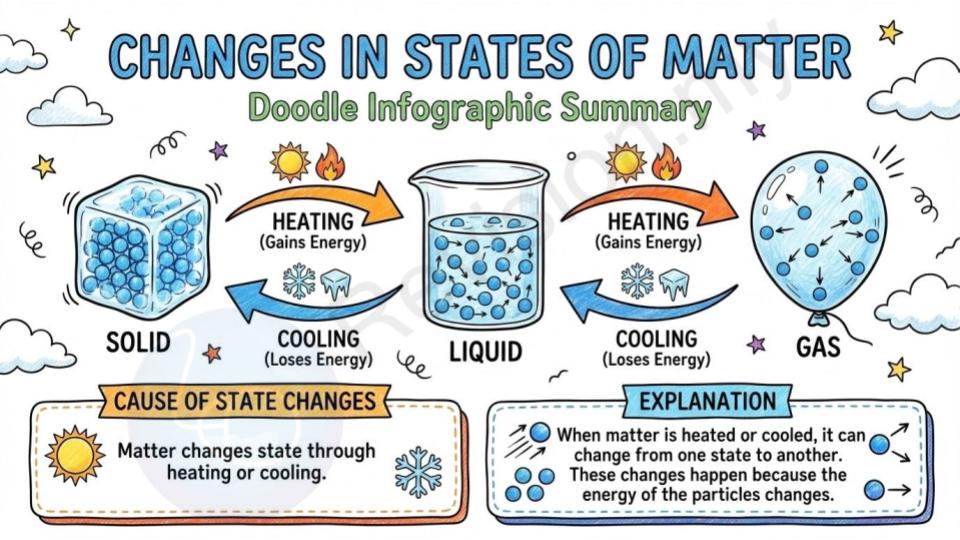
Cause of state changes: When matter is heated or cooled, it can change from one state to another. These changes happen because the energy of the particles changes.
Melting (Solid to Liquid)
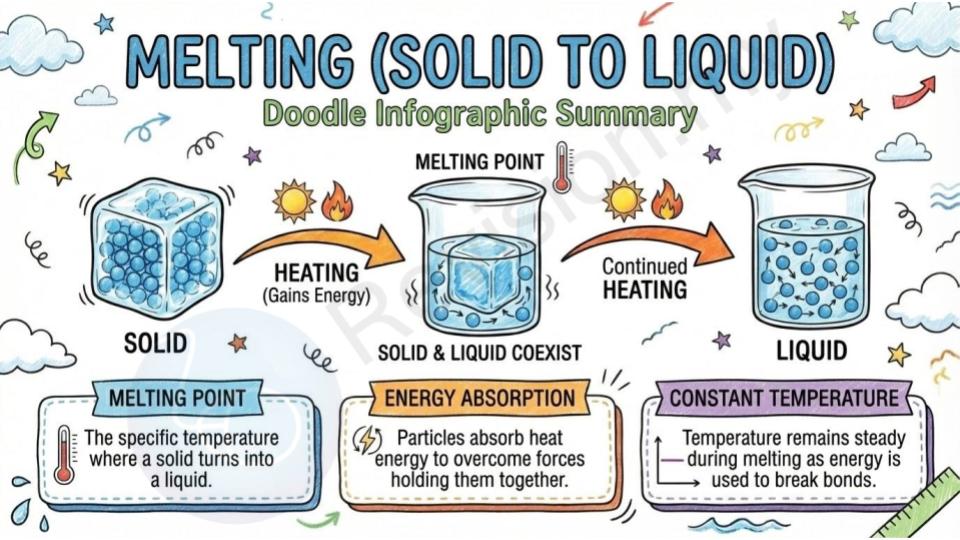
Particle behavior during melting: When a solid is heated, its particles gain energy and start to vibrate more strongly.
Overcoming forces in melting: As the particles gain more energy, the forces holding them tightly in place become weaker, allowing the particles to move.
Melting point: The temperature at which a solid turns into a liquid is called the melting point. It’s a specific temperature for each substance.
Energy absorption: The particles in solid absorb heat energy and use it to break the forces holding them together.
Constant temperature: While melting, the temperature does not increase even though heat is being added. This is because all the energy is used to break bonds.
Dual phase presence: During the melting process, both solid and liquid are present together.
Freezing (Liquid to Solid)
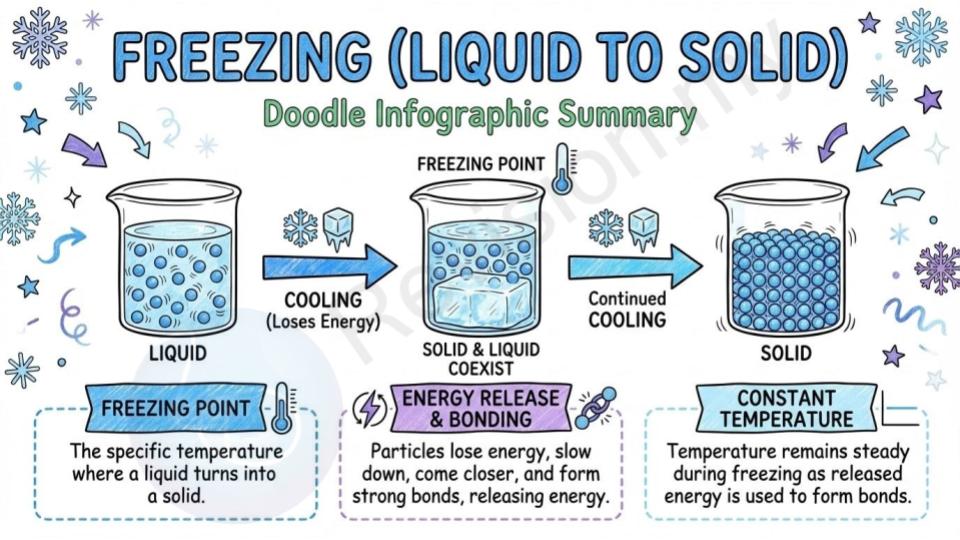
Particle behavior during freezing: When a liquid is cooled, its particles lose energy and start moving more slowly.
Bonding during freezing: As the particles slow down, they move closer together and start to stick to each other more strongly.
Freezing point: The temperature at which a liquid turns into a solid is called the freezing point.
Energy release: When a substance freezes, its particles release energy as they form bonds and become a solid.
Constant temperature during freezing: While freezing, the temperature remains steady because the energy released is used to make bonds.
Dual phase presence in freezing: Both liquid and solid forms of a substance exist together while it freezes.
Boiling/Evaporation (Liquid to Gas)
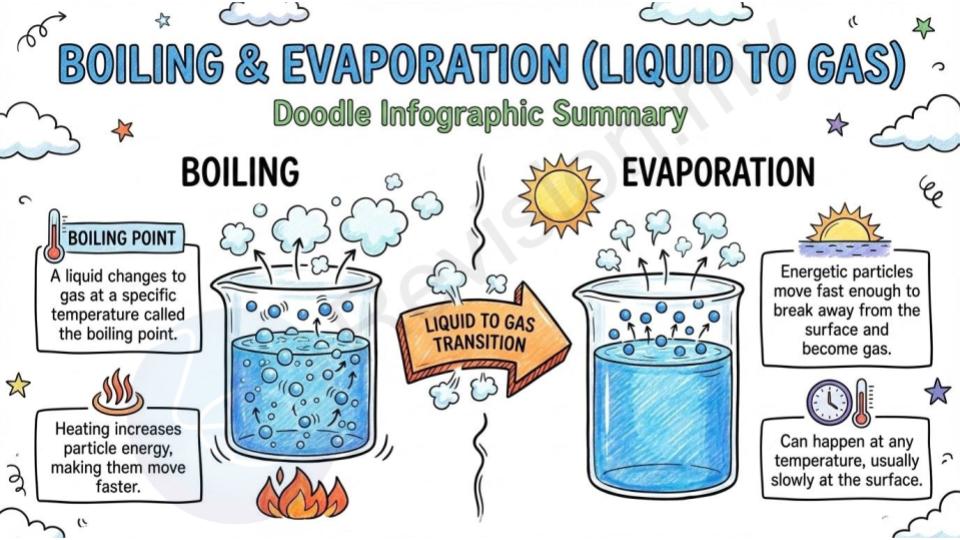
Particle behavior during boiling: When a liquid is heated, its particles gain energy and move much faster.
Escape from liquid: The energetic particles move so fast that they can break away from the liquid and become gas.
Boiling point: The temperature at which a liquid becomes a gas is called the boiling point. It’s different for each substance.
Evaporation conditions: Evaporation can happen at any temperature, not just at the boiling point. It usually happens slowly at the surface of a liquid.
Condensation (Gas to Liquid)
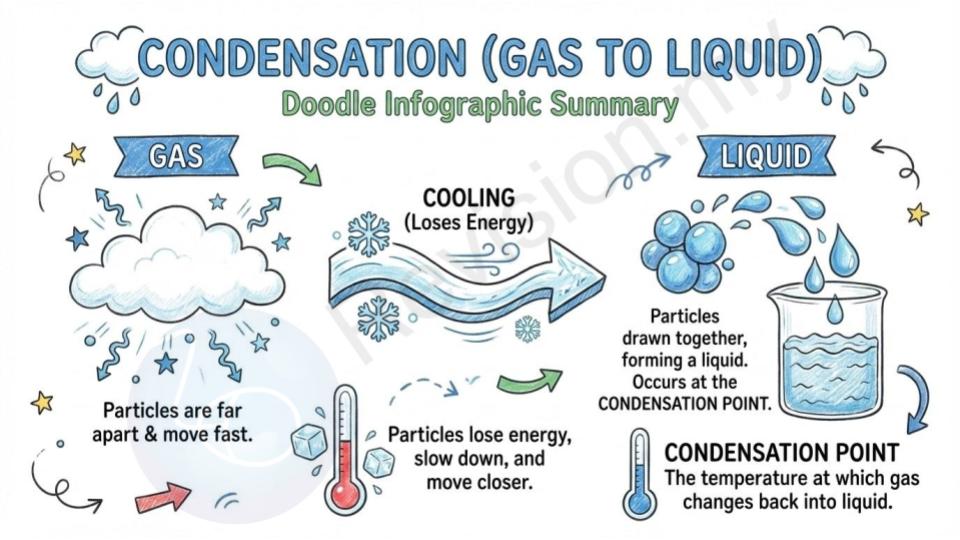
Particle behavior during condensation: When gas is cooled down, its particles lose energy and begin to move more slowly.
Formation of liquid: The slower particles start to come together and form a liquid again.
Condensation point: The temperature at which gas changes back into liquid is called the condensation point.
Sublimation and Deposition
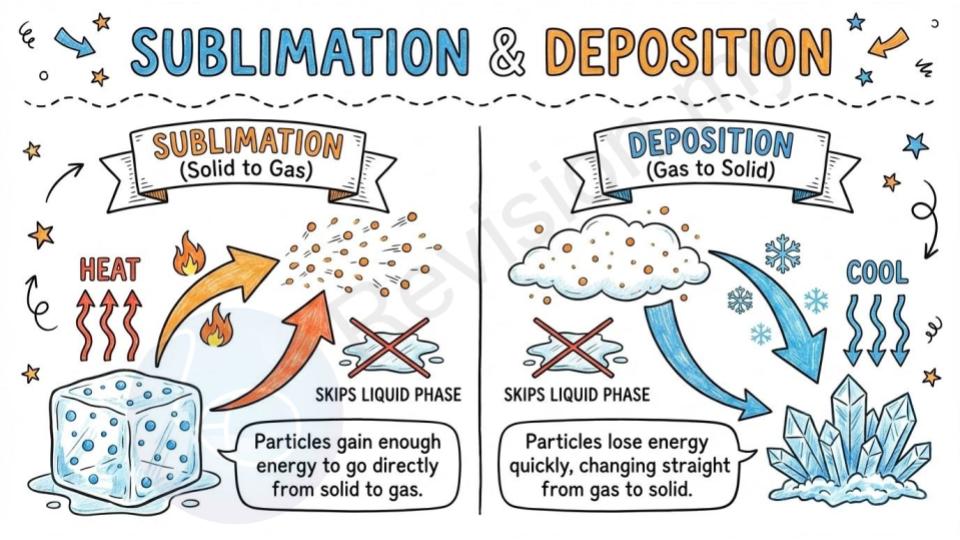
Solid to gas: When a solid is heated strongly, some of its particles may gain enough energy to go straight into the gas state without becoming a liquid. This process is called sublimation.
Gas to solid: When gas particles lose a lot of energy quickly, they can change straight into solid without becoming a liquid. This process is called deposition.
Heating Curve of Naphthalene
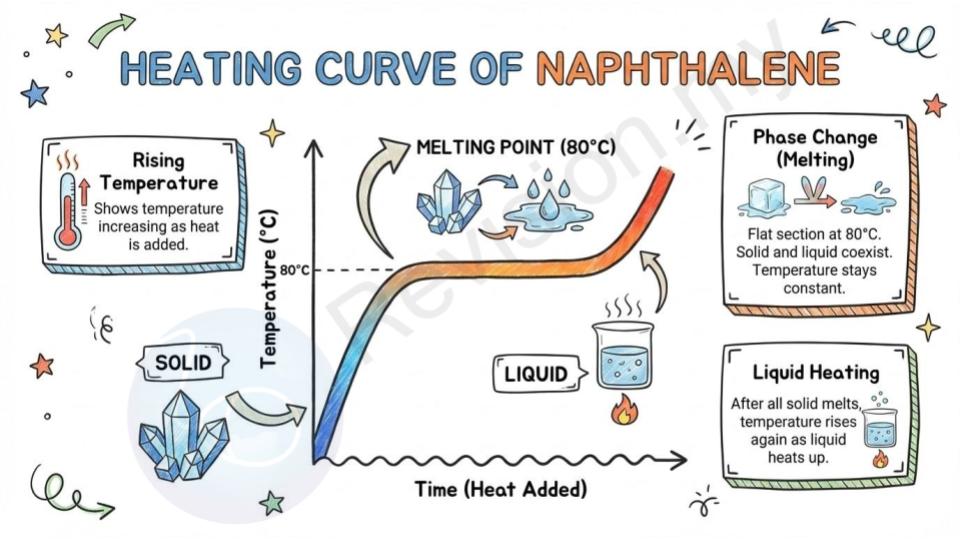
Heating curve description: A heating curve is a graph that shows how the temperature of a substance increases as heat is added. It includes flat parts where the state of matter is changing.
Flat section at melting point: The flat line on the heating curve at 80°C shows that naphthalene is melting. It exists as both a solid and a liquid.
Post-melting temperature rise: After all the solid has melted, the temperature starts to rise again as the liquid heats up.
Cooling Curve of Naphthalene
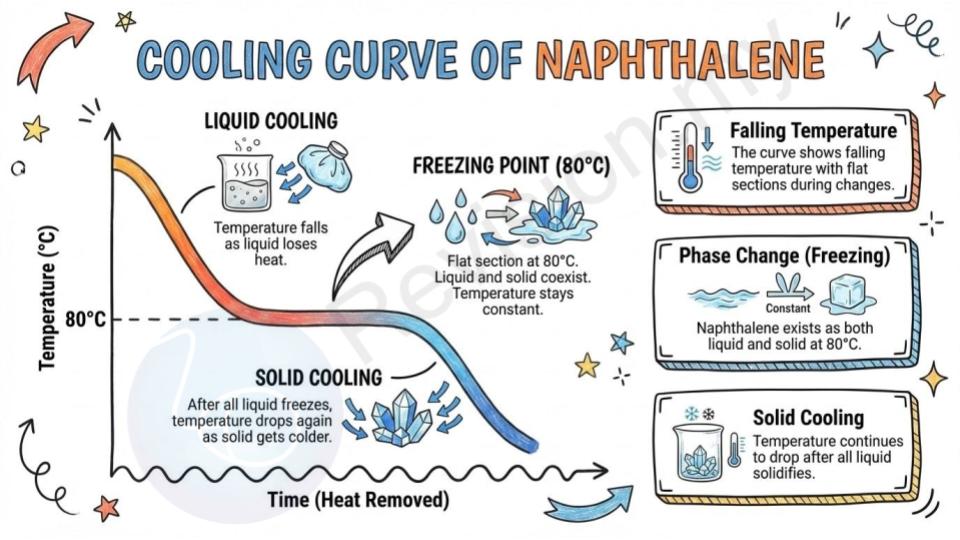
Cooling curve description: A cooling curve is a graph that shows how the temperature of a substance decreases as heat is removed. Flat sections appear during state changes.
Flat section at freezing point: The flat part of the curve at 80°C shows that naphthalene is freezing and both liquid and solid are present.
Post-freezing temperature drop: After the entire liquid has frozen, the temperature continues to go down as the solid gets colder.